Charity / Healthcare / Not-for-Profit · 2025
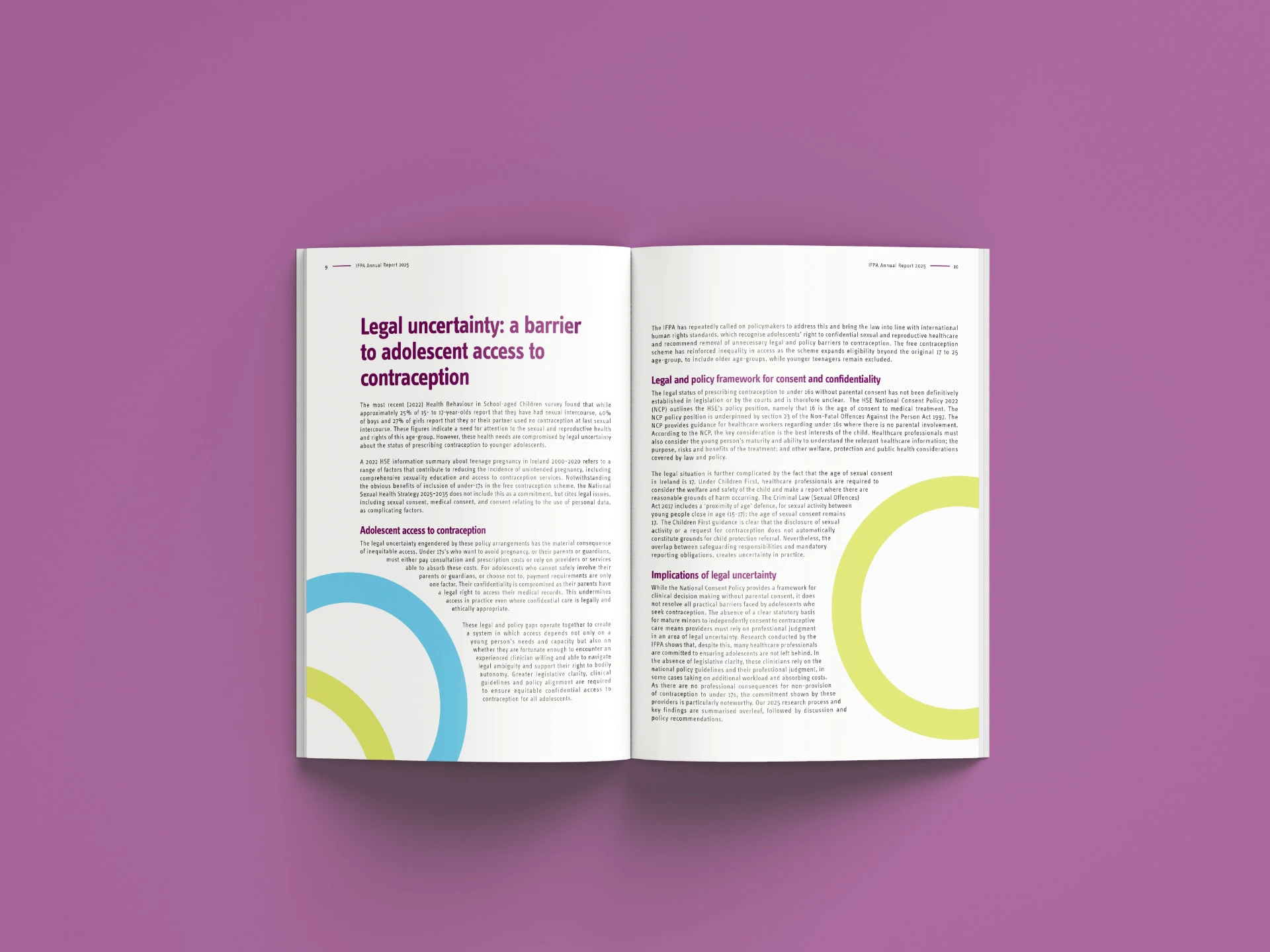
IFPA Annual Report 2025
A 48-page annual report for the Irish Family Planning Association (IFPA), bringing together clinical services, research, advocacy, organisational achievements, governance and financial reporting in a cohesive, professionally designed publication.
Communicating a year of healthcare, research and advocacy
The Irish Family Planning Association (IFPA) is a specialist not-for-profit provider of sexual and reproductive healthcare and a leading voice in shaping Ireland's sexual and reproductive health and rights agenda.
Its work spans clinical healthcare, counselling, education, research and national and international advocacy. The organisation provides a wide range of specialist services, including contraception, abortion care, cervical screening, STI testing, menopause care and support for survivors of female genital mutilation.
The IFPA's annual report needs to communicate the breadth of this work while presenting detailed information in a way that is clear, accessible and engaging for its stakeholders.
For the 2025 Annual Report, Pixelo Design developed a 48-page publication that brings together the organisation's clinical achievements, research findings, advocacy activities, communications, governance and financial information within a consistent editorial design.
The challenge was to create a publication that could accommodate substantial amounts of specialist healthcare information without losing its readability, visual appeal or professional character.
The challenge: making complex information accessible
Annual reports for healthcare organisations present a particular design challenge.
They often need to communicate a combination of clinical information, research findings, service statistics, policy developments and organisational performance. Each requires a different approach to presenting information, while the publication as a whole needs to feel consistent and cohesive.
The IFPA's 2025 report covered a particularly broad range of subjects.
Alongside messages from the Chairperson and CEO, the publication explored contraception provision, adolescent access to healthcare, early abortion care, female genital mutilation treatment, sexual health screening, menopause care and specialist counselling.
It also included qualitative research into the barriers facing young people seeking contraception, public opinion polling, international advocacy activities, organisational communications and detailed financial statements.
The design needed to give each subject sufficient space and visual distinction while maintaining a recognisable publication style throughout.
Creating a consistent visual identity
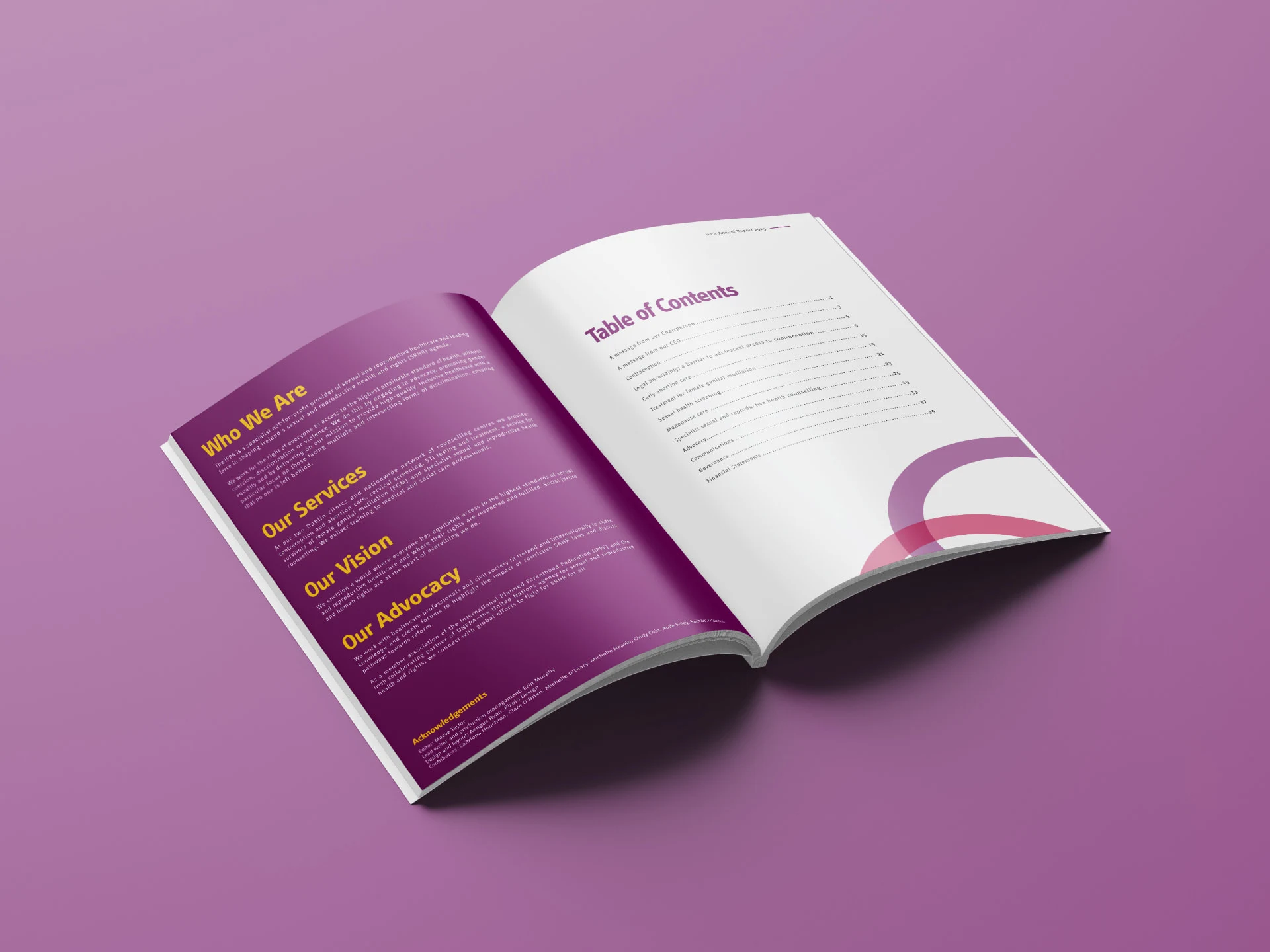
The publication uses the IFPA's distinctive purple and yellow colour palette as the foundation of its visual identity.
These colours provide continuity throughout the report, while carefully introduced variations in layout, typography, photography and background treatments help distinguish individual sections.
Large, confident section headings establish a clear hierarchy, allowing readers to identify subjects quickly. Supporting typography and carefully structured text layouts ensure that detailed editorial content remains readable.
The use of colour is particularly effective in separating key information from supporting narrative. Coloured panels, highlighted quotations and contrasting page backgrounds create visual interest without distracting from the subject matter.
This approach gives the publication a strong identity while allowing the content to remain the focus.
Balancing editorial content with visual storytelling
A substantial annual report should not feel like 48 pages of uninterrupted text.
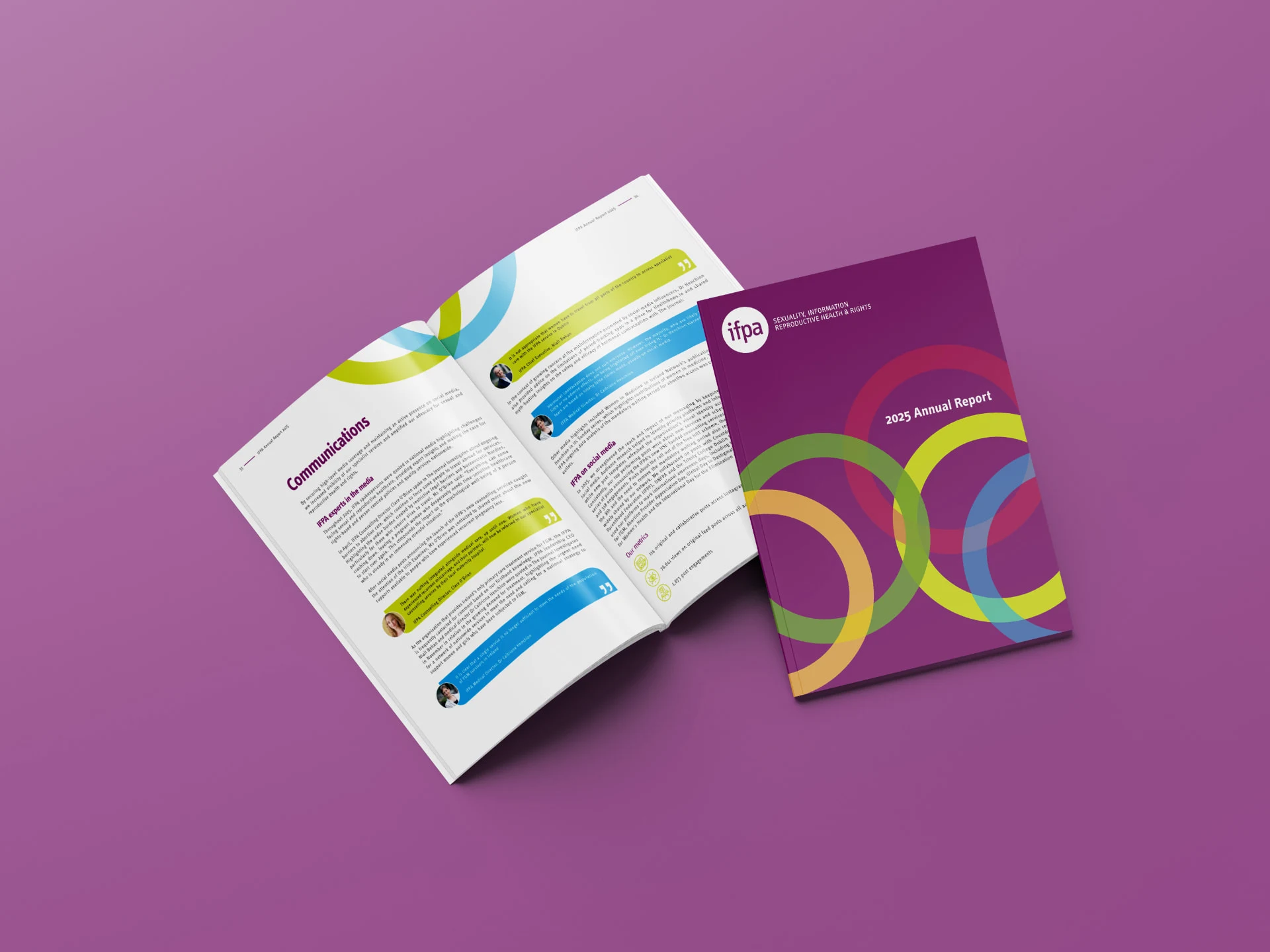
Throughout the IFPA publication, we used a combination of editorial layouts, photography, pull quotes and visual elements to create variety and improve the reading experience.
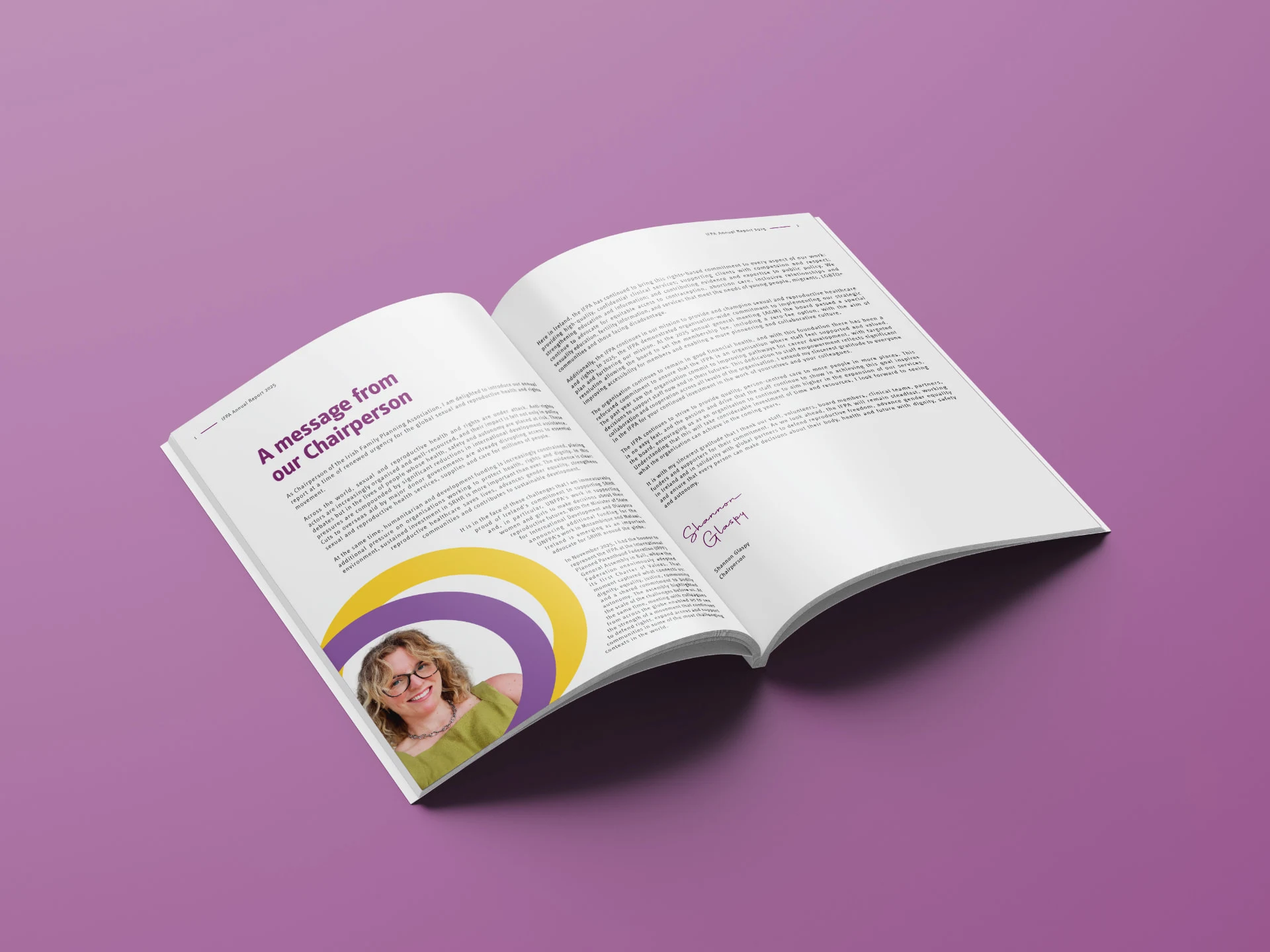
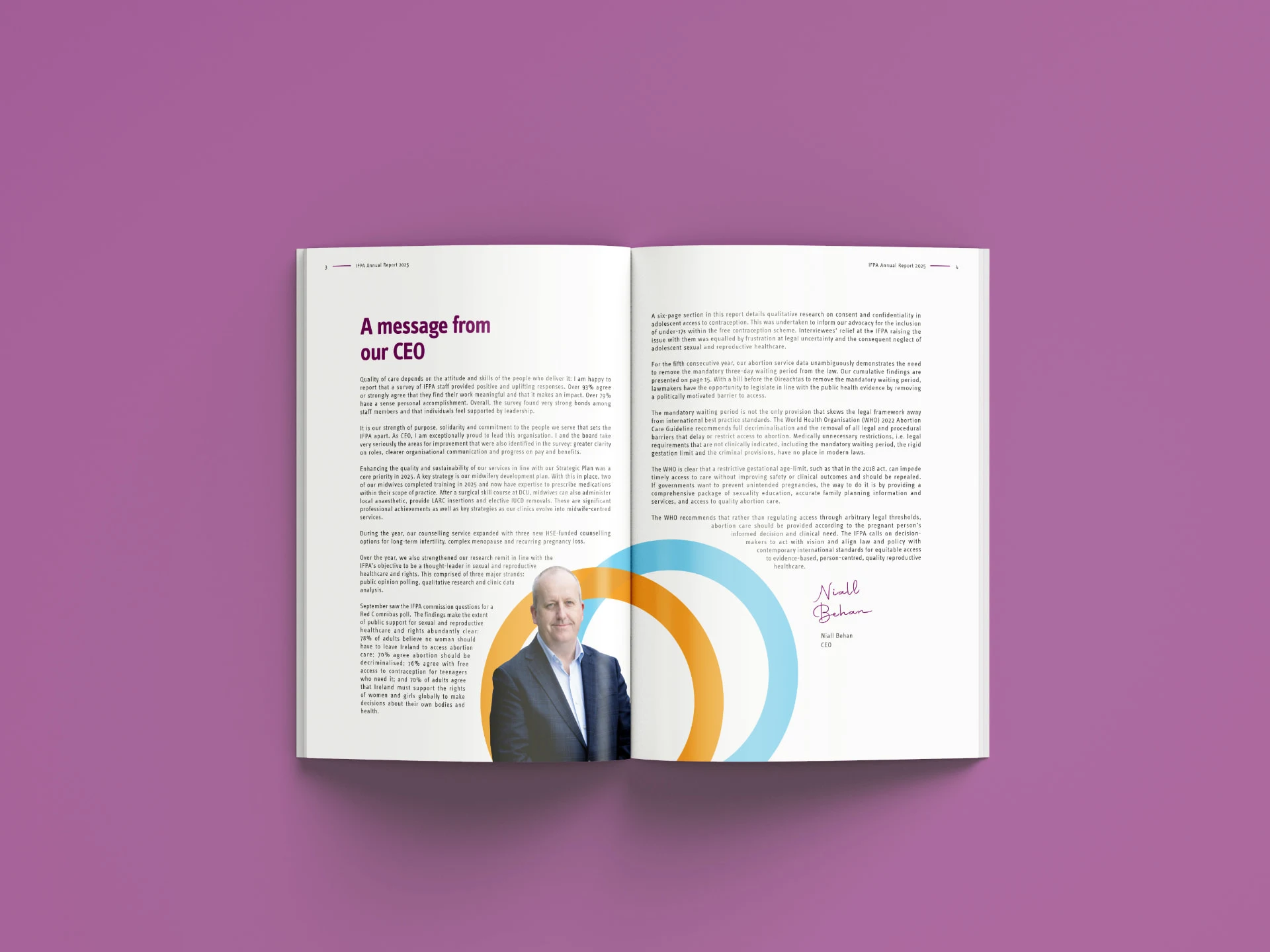
Leadership messages, clinical perspectives and specialist contributions are given prominence through dedicated layouts that combine photography with highlighted quotations and supporting text.
For example, the opening messages from the Chairperson and CEO use distinct editorial treatments to introduce the organisation's priorities and achievements.
Elsewhere, staff photography and contributor profiles help put a human face to the services being described.
This balance between written content and visual storytelling is particularly important for organisations working in healthcare and the not-for-profit sector, where communicating the human impact of services is just as important as reporting operational achievements.
Presenting research and statistics with clarity
One of the most important aspects of the IFPA's annual report is its use of evidence to support its work and advocacy.
The publication contains extensive service data, research findings, percentages and comparative statistics. Presenting this information clearly is essential to helping readers understand both the scale of the organisation's work and the issues it is addressing.
The report includes several examples of information-led design.
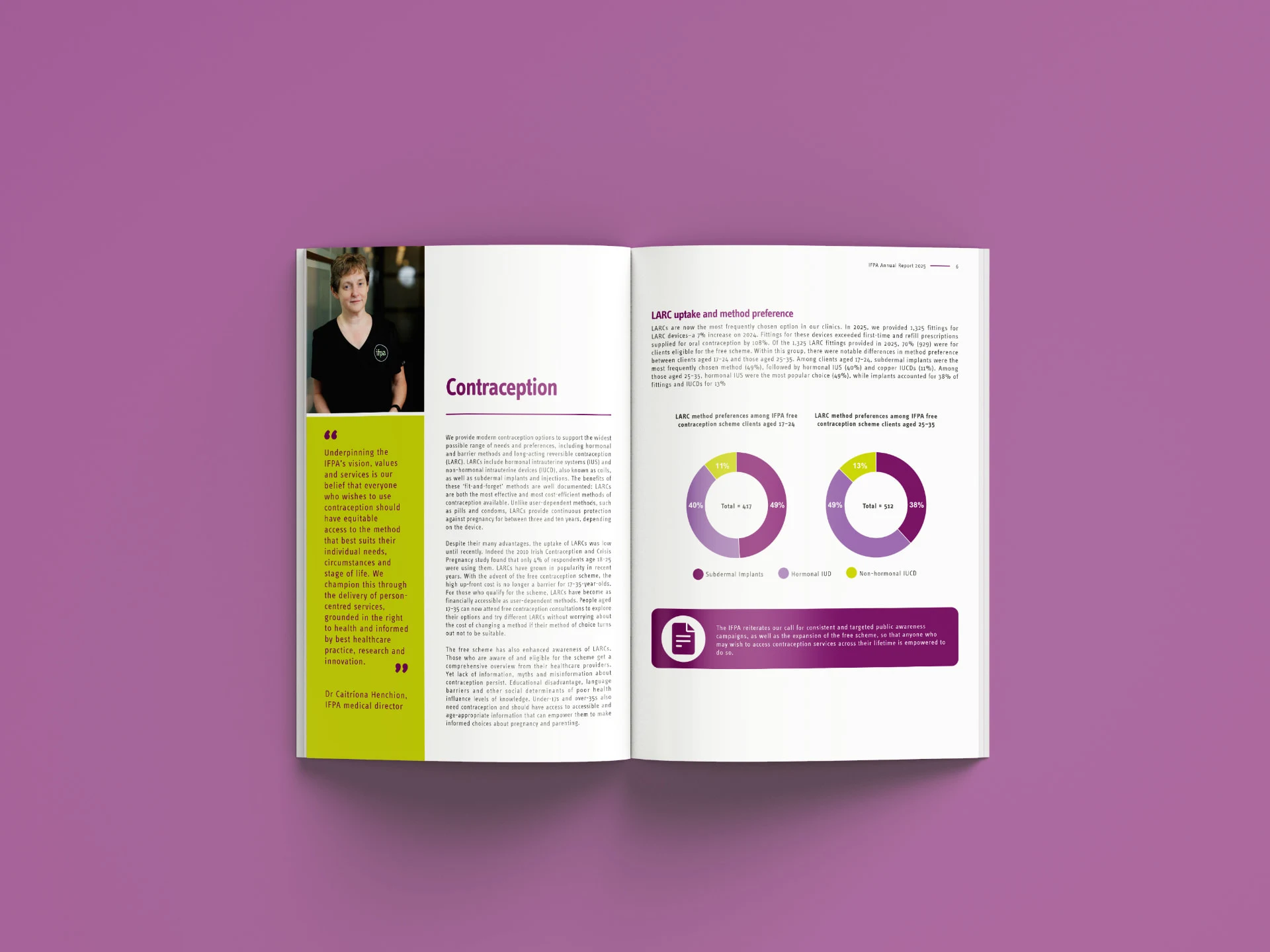
The contraception section, for example, presents data on the uptake of long-acting reversible contraception (LARC), including comparisons between different age groups and their preferred methods.
The early abortion care section combines five years of service data with a clearly structured outcomes table, making important findings easier to interpret.
Elsewhere, the communications section highlights social media performance, while the advocacy section presents findings from public opinion polling.
Rather than treating statistics as supporting material buried within paragraphs, the publication gives important figures greater prominence through considered typography, spacing and layout.
The result is a report that helps readers identify key information without having to work through every paragraph.
Giving important issues the space they deserve
The IFPA's work involves complex and sometimes sensitive subjects, including reproductive rights, adolescent healthcare, abortion access and female genital mutilation.
These subjects require careful communication and an appropriate visual approach.
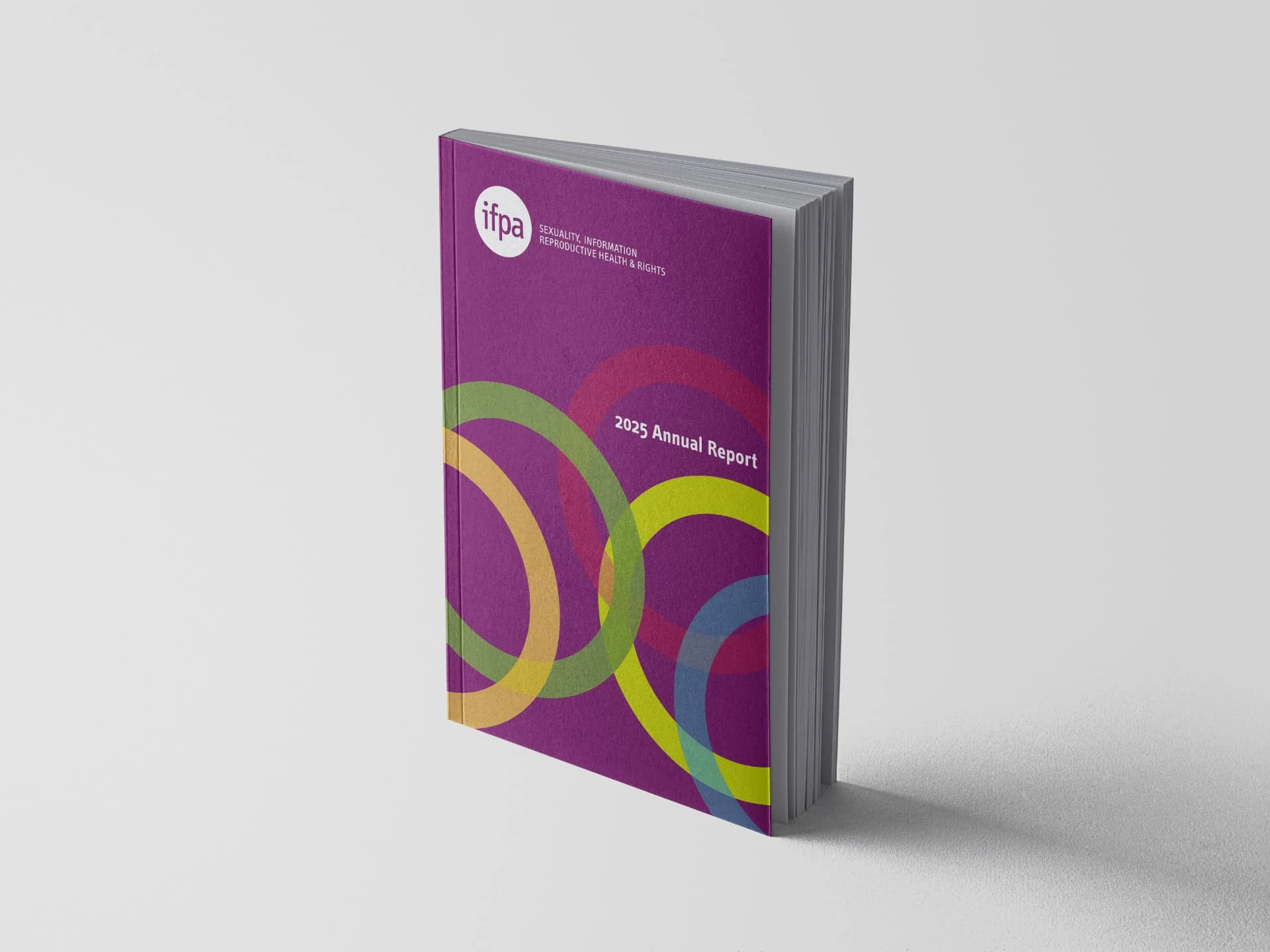
The report's six-page section on adolescent access to contraception is a particularly important example. It presents original qualitative research, including the experiences of healthcare professionals, key findings, discussion and policy recommendations.
The design needs to accommodate lengthy research content, interview quotations and supporting explanations while maintaining a clear reading sequence.
Similarly, the sections covering specialist counselling and clinical services combine detailed explanations with photography, highlighted commentary and clearly defined content areas.
By allowing these subjects to develop across dedicated pages, the publication avoids overcrowding and gives readers the opportunity to engage with the information at their own pace.