What Is the Best Binding for Your Annual Report? A Guide to Saddle Stitching, Perfect Binding and PUR Binding
Introduction: Why Binding Matters More Than You Think
When planning an annual report, most organisations concentrate on the content, photography, charts, financial information and overall design. These are all essential considerations, but there is another decision that deserves just as much attention: how the report will be bound.
Binding determines how the pages are held together, how the report feels in the reader's hands, how easily it opens, and how well it withstands handling. It also has a significant influence on the publication's appearance and the impression it creates.
Think about the difference between a thin booklet held together with two staples and a substantial corporate publication with a smooth, printed spine. Both can communicate the same information, but they create very different experiences for the reader.
For an organisation publishing its annual report, that distinction matters. Your report might be presented to shareholders, distributed to customers, sent to government departments, shared with funding partners or published as part of your sustainability and corporate responsibility communications. It represents your organisation, its achievements and its ambitions.
The binding should reflect that purpose.
A charity producing a concise annual review may need an economical, lightweight publication that can be distributed widely. A large company publishing a detailed financial report may want a more substantial finish that communicates professionalism and permanence. A public-sector organisation producing a comprehensive report might need a balance between durability, accessibility, presentation and cost.
There is no single binding method that is right for every annual report. However, for organisations seeking a premium, professional finish, PUR binding and traditional perfect binding are often excellent choices. Both produce a clean, book-like appearance, although PUR binding generally offers superior adhesive performance and durability.
Saddle stitching, meanwhile, remains an excellent option for shorter publications where affordability, simplicity and ease of use are priorities.
In this guide, we will examine the most common annual report binding options, explain their strengths and limitations, and help you determine which is best suited to your next publication. We will also explore how Pixelo Design can help you choose a binding method that complements your report's design, budget and intended audience.
1. What Is Binding, and Why Is It Important for Annual Reports?
Binding is the process of securing the individual pages of a publication together to create a finished booklet or book.
Although it might appear to be a purely technical printing decision, binding affects several aspects of the final product.
First impressions
The binding contributes to the perceived quality of your publication. A neatly finished spine, accurately aligned cover and clean edges can make a report feel more substantial and considered.
This is particularly relevant for annual reports that form part of an organisation's formal communications. The finished publication should feel consistent with the quality of the organisation's brand.
Durability
Some reports are read once and recycled. Others are kept in offices, passed between colleagues, referenced during meetings or retained for future reference.
A publication that will be handled frequently needs a binding method capable of withstanding repeated use. The paper, cover stock, adhesive and construction all influence durability.
Usability
The way a report opens can affect how comfortable it is to read.
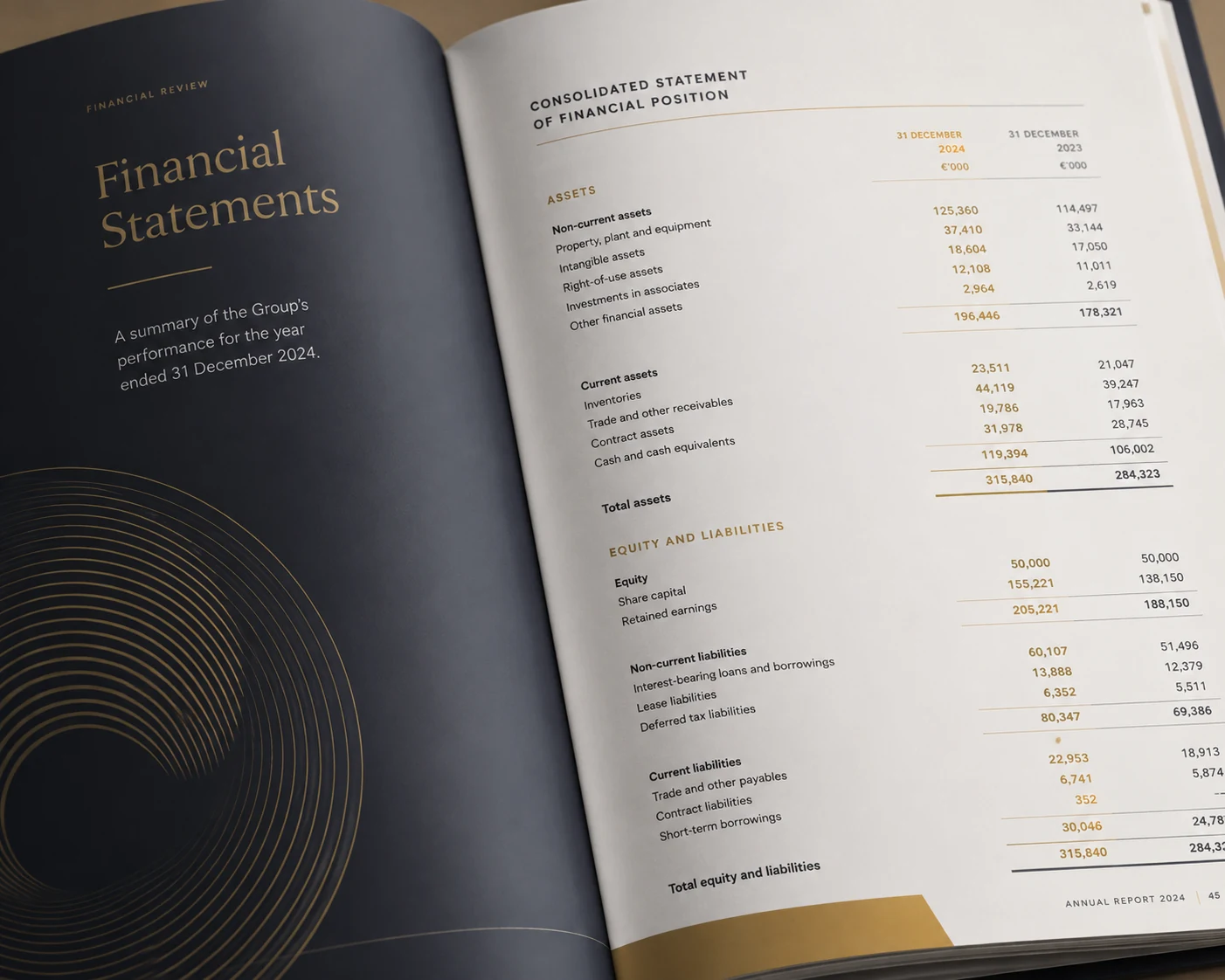
A report containing financial tables, detailed infographics or charts that extend across two pages needs to open sufficiently to make that information easy to follow. The binding should support the layout rather than interfere with it.
Design flexibility
Different binding methods offer different possibilities for the cover, spine and page layout.
Perfect-bound publications have a printable spine that can display the organisation's name, report title or reporting year. Saddle-stitched booklets do not have the same conventional, printable spine.
These differences influence how the designer approaches the publication.
Cost and production
Binding also affects the overall production budget. The number of pages, paper specification, print quantity, production method and finishing requirements can all influence the cost.
The most economical binding option is not necessarily the best value. If the publication is intended to represent a premium brand, investing in a more substantial finish may be worthwhile. Conversely, spending more on binding for a short, frequently distributed information booklet may offer little practical benefit.
The ideal choice balances presentation, practicality, durability and budget.
2. Saddle Stitching: An Excellent Choice for Shorter Reports
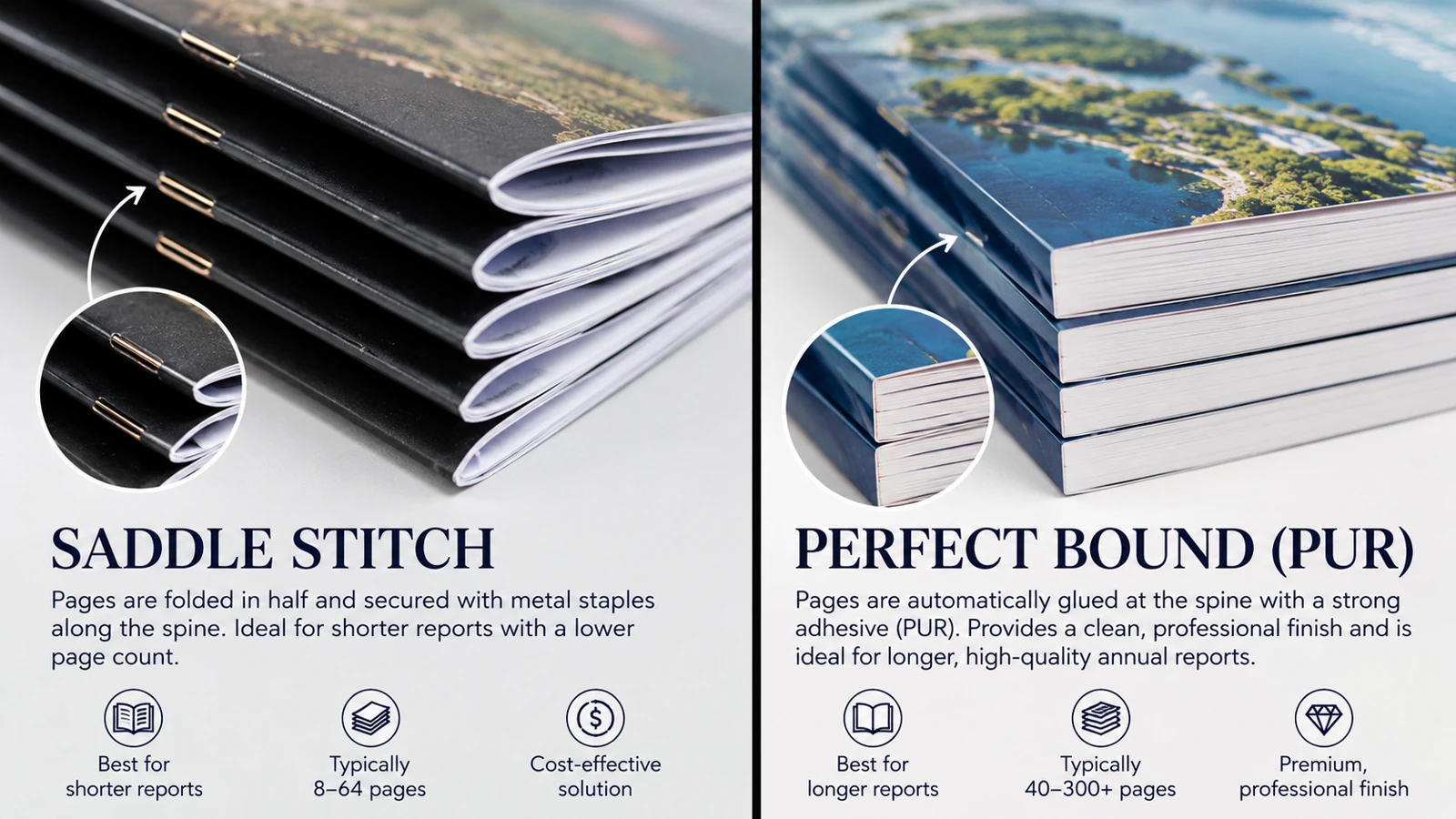
Saddle stitching is one of the most familiar and economical binding methods used for brochures, magazines, programmes and shorter annual reports.
Despite the name, the process does not involve sewing. Instead, printed sheets are folded together and secured through the fold using metal staples.
The folded sheets are nested inside one another, creating a booklet that opens along its centre fold.
How saddle stitching works
The pages of a saddle-stitched publication are printed on larger sheets, folded and gathered in the correct sequence. Staples are then driven through the centre fold to secure the pages.
The publication is trimmed to its finished size, producing a neat booklet.
Because the pages are nested together, the total page count generally needs to be a multiple of four. The exact practical page limit depends on paper thickness, format, equipment and the printer's specifications.
For a relatively short annual review, this can be an efficient and cost-effective solution.
The advantages of saddle stitching
1. Cost-effective production
Saddle stitching is generally one of the most economical ways to bind a short publication.
The process is straightforward, requires relatively little finishing material and can be highly efficient for suitable print runs.
For charities, community organisations and smaller businesses working within a limited budget, this can make saddle stitching an attractive option.
2. Lightweight and easy to distribute
Saddle-stitched reports are relatively lightweight and compact.
This makes them useful for publications distributed at conferences, annual general meetings, exhibitions, stakeholder events or through direct mail.
If your organisation needs to distribute a large number of short annual reviews, keeping weight and bulk down can be beneficial.
3. Good usability for shorter publications
Saddle-stitched booklets can open comfortably, particularly when the page count and paper specification are appropriate.
The folded construction can make them convenient to hold and read, while the centre fold allows the reader to move naturally through the publication.
They can work particularly well for reports featuring photographs, short articles, highlights and concise financial summaries.
4. Fast production
Saddle stitching is an established finishing method. For suitable jobs, it can offer an efficient production process.
This can be useful when an annual report must be completed within a tight publication schedule.
5. Plenty of design possibilities
Saddle stitching does not have to look basic. A thoughtfully designed cover, high-quality paper, considered typography and carefully selected images can produce an attractive and professional result.
The absence of a conventional spine does not prevent the publication from looking polished.
The disadvantages of saddle stitching
Despite its advantages, saddle stitching is not suitable for every annual report.
Limited suitability for thick publications
As more pages are added, the folded booklet becomes thicker and more difficult to finish neatly. Thick paper can make the problem more pronounced.
The outer pages may also extend farther than the inner pages during folding, a phenomenon known as creep. Printers account for this when imposing and trimming the pages, but it becomes increasingly relevant as the booklet grows.
A substantial annual report containing numerous financial statements, detailed commentary and multiple case studies may therefore be better suited to another binding method.
No conventional printable spine
Saddle-stitched publications have a folded edge rather than a flat, square spine.
This is rarely a problem for a short report, but it matters if the publication will be displayed on a shelf or stored alongside other corporate reports.
The staples remain visible
The metal staples are a normal part of the construction. They can be neatly applied, but they do not create the seamless, book-like finish associated with adhesive binding.
For organisations seeking a particularly refined or premium appearance, this may be a consideration.
When should you choose saddle stitching?
Saddle stitching is worth considering when:
- Your annual report is relatively short.
- You want to keep printing costs under control.
- The publication will be distributed in large quantities.
- Portability and low weight are important.
- You prefer a simple booklet format rather than a conventional book-like publication.
For example, a charity producing a 24-page annual review with photographs, key achievements and a short financial overview could be well served by saddle stitching.
A larger organisation producing a detailed 100-page annual report, however, would generally need to consider alternative binding methods.
The important point is that saddle stitching can be an excellent choice when it suits the publication. It should not be dismissed as an inferior option simply because it is economical.
3. Perfect Binding: A Clean, Professional, Book-Like Finish
Perfect binding is widely used for corporate publications, annual reports, magazines, catalogues and books.
It creates the familiar appearance of a paperback book, with a flat spine, a separate cover and pages secured along the spine edge using adhesive.
For many annual reports, perfect binding represents an effective balance between presentation, practicality and production cost.
How perfect binding works
The pages are arranged into a block, and their spine edges are prepared to help the adhesive bond to the paper.
Adhesive is applied to the spine, and the cover is wrapped around the assembled pages. Once the adhesive has set, the publication is trimmed to create clean, even edges.
The finished report has a square spine that can be printed with the report title, organisation's name and reporting year, provided there is sufficient spine width.
This gives the publication a more substantial, book-like appearance than a typical saddle-stitched booklet.
The advantages of perfect binding
1. A professional appearance
One of the main reasons organisations choose perfect binding is its clean, understated finish.
The square spine creates a recognisable book format, making the report feel like a considered corporate publication rather than a simple booklet.
For annual reports intended for shareholders, investors, funding partners or senior stakeholders, this can be an important advantage.
2. A printable spine
The spine provides additional space for branding and identification.
When reports are placed on shelves, the printed spine can make them easier to identify. It can also create a consistent appearance across a series of annual publications.
For an organisation that produces an annual report every year, maintaining the same cover layout and spine treatment can help establish a recognisable visual identity.
3. Suitable for a wide range of page counts
Perfect binding is particularly useful for medium and longer publications.
A report with numerous sections, photographs, infographics, case studies and financial tables can be produced in a book-like format without the limitations associated with a thick saddle-stitched booklet.
The appropriate minimum and maximum page counts depend on the paper, binding equipment and printer.
4. Flexible cover design
Perfect-bound covers can be printed on a heavier stock than the internal pages and finished with a variety of treatments.
Options may include matt or gloss lamination, soft-touch finishes, spot UV varnish and selected metallic or textured effects, depending on the printer's capabilities.
These finishes can add visual interest without requiring an elaborate cover design.
For example, a sustainability report might use an understated matt cover with a strong environmental image and restrained typography. A corporate financial report might feature a bold colour, crisp branding and a minimalist layout.
5. Good value for substantial publications
Perfect binding can provide a professional finish without the expense or complexity of more elaborate bookbinding methods.
For organisations that need a substantial report but do not require a hardback cover, it can be an effective solution.
The disadvantages of perfect binding
Perfect binding has some limitations that need to be considered during the design and production process.
The report does not always lie flat
A perfect-bound publication generally has to be opened by hand and will not naturally lie completely flat like some other formats.
This can affect the reading experience when the report contains wide tables, charts or images spanning two pages.
A good designer accounts for this when planning the layout, ensuring important information is not lost in the spine.
The adhesive and paper influence durability
Perfect binding relies on the adhesive forming a reliable bond with the pages and cover.
The performance of the finished publication depends on the adhesive system, paper characteristics, preparation, manufacturing conditions and how the report is handled.
Traditional perfect binding commonly uses EVA hot-melt adhesive. While this can perform well for many publications, it may not offer the same flexibility and resistance to demanding conditions as PUR adhesive.
Spine width must be calculated accurately
The spine width depends on the number of pages and the thickness of the paper.
A thicker paper specification creates a wider spine, while a lighter paper stock produces a narrower one.
This needs to be calculated before the cover artwork is finalised. Otherwise, the spine text, artwork and cover alignment may not fit as intended.
When should you choose perfect binding?
Perfect binding is a strong option when:
- You want a professional, paperback-style publication.
- Your report contains a moderate or large number of pages.
- A printed spine would be useful.
- You want a premium appearance without a hardback cover.
- You need a good balance between presentation and cost.
For a corporate annual report with a substantial amount of content, perfect binding can deliver the polished finish many organisations are looking for.
However, there is another option worth considering if durability and binding performance are particularly important: PUR binding.
4. PUR Binding: A Premium Option for Annual Reports
PUR binding is an adhesive binding method that uses polyurethane reactive adhesive.
It is closely related to perfect binding in appearance and construction, but it uses a different adhesive technology.
This distinction is important because PUR is not necessarily a completely separate alternative to perfect binding. Rather, PUR binding is a form of adhesive perfect binding that uses PUR adhesive instead of conventional adhesive systems such as EVA hot melt.
When a printer offers PUR binding, it is worth asking whether the quoted specification includes the particular paper, cover and finishing requirements for your report.
For organisations seeking a refined annual report that also needs to withstand repeated handling, PUR is often an excellent choice.
How PUR binding works
The pages are gathered into a block and prepared at the spine so that the adhesive can bond effectively to the paper.
PUR adhesive is applied to the spine, and the cover is attached around the page block.
The adhesive then reacts with moisture and cures to form a strong, flexible bond. This curing process differs from the way conventional EVA hot-melt adhesives set.
The result is a professionally finished publication with a flat spine and a clean, book-like appearance.
The exact production process varies according to the printer's equipment and the materials being used.
The advantages of PUR binding
1. Strong, flexible adhesive performance
One of the principal advantages of PUR is its combination of bond strength and flexibility.
This can be particularly valuable for annual reports that will be handled frequently, retained for future reference or produced using papers that are more challenging to bind.
A well-produced PUR-bound report can withstand regular use while maintaining the integrity of the page block.
No binding method is indestructible, of course. The performance of the finished publication still depends on the paper, cover, preparation and manufacturing quality.
2. Excellent compatibility with a range of paper stocks
Some coated and digitally printed papers can be more challenging to bind reliably using conventional adhesive systems.
PUR can provide advantages in these situations, although suitability must be confirmed for the specific paper and production process.
This flexibility can be useful when a report's design calls for coated stock, substantial photography or a particular combination of paper finishes.
If your annual report includes high-quality photographs, full-colour infographics and detailed data visualisations, you may have a strong reason to consider a premium adhesive binding method.
3. A premium, professional appearance
PUR-bound publications can have the same clean, square spine and refined appearance associated with perfect-bound books.
The finished report can look substantial and professional without needing a hardback cover.
This makes PUR particularly suitable for corporate annual reports, sustainability reports, ESG publications and other documents that represent an organisation to important stakeholders.
4. Good resistance to repeated handling
The flexibility of PUR adhesive can help the binding withstand the stresses associated with opening and closing a publication.
This can be beneficial when an annual report is intended to be read, referenced and kept rather than simply distributed as a short-term marketing document.
The practical lifespan still depends on how the report is used and stored, but PUR is a strong candidate when durability is a priority.
5. A good option for premium paper specifications
If you are investing in a carefully designed publication with a distinctive cover, high-quality paper and strong visual content, it makes sense to consider a binding method that supports the overall specification.
PUR can be particularly attractive when the report needs to combine a premium finish with a durable construction.
Are there any disadvantages to PUR binding?
PUR is not automatically the best choice for every project.
Potentially higher production costs
PUR binding can cost more than conventional perfect binding, depending on the printer, production volume, equipment and job specifications.
For a short publication with a limited lifespan, the additional investment may not be necessary.
Specialised production requirements
PUR binding requires appropriate equipment and controlled production conditions. The adhesive also needs time to cure properly.
These requirements can affect production planning and turnaround times.
Not every printer offers it
Some printers specialise in particular types of finishing, while others may not offer PUR binding for every paper size, print run or publication format.
It is therefore worth confirming availability early in the project rather than assuming that every printer can provide it.
It will not make every design problem disappear
PUR binding still has a spine and does not automatically allow a publication to lie completely flat.
If your report contains extensive double-page tables or information that must be read across the centre fold, the designer should consider the layout carefully.
When should you choose PUR binding?
PUR binding is particularly worth considering when:
- Your annual report needs a premium, professional appearance.
- The publication will be handled frequently.
- You are using coated or specialist paper stocks.
- You want a strong, flexible adhesive bond.
- Your report is substantial enough to benefit from a square spine.
- Durability is important alongside presentation.
For a company publishing a detailed annual report for investors, a government agency producing a substantial public document, or a charity creating a comprehensive impact report, PUR can be an excellent choice.
If the budget allows and the printer confirms that it is suitable for your specification, it is often a sensible upgrade to consider.
5. PUR Binding vs Perfect Binding: Which Is Better?
This is one of the most common questions when choosing a binding method for an annual report.
The first thing to understand is that the two terms are not always directly comparable. Perfect binding describes the general style of construction, while PUR describes the adhesive technology used in one type of perfect binding.
In practice, when printers compare PUR binding with perfect binding, they often mean PUR adhesive versus conventional EVA hot-melt adhesive.
Both can produce an attractive, professional publication. The key differences concern adhesive performance, suitability, production requirements and cost.
| Feature | Conventional perfect binding | PUR binding |
|---|---|---|
| Construction | Adhesive-bound book block | Adhesive-bound book block |
| Common adhesive | EVA hot melt | Polyurethane reactive adhesive |
| Appearance | Clean, square spine | Clean, square spine |
| Durability | Suitable for many standard publications | Often offers a stronger, more flexible bond |
| Paper compatibility | Depends on paper and adhesive | Can be advantageous with certain coated papers |
| Production | Established and widely available | Requires suitable equipment and curing |
| Cost | Often more economical | May cost more |
| Best suited to | Standard corporate publications | Premium publications where bond performance matters |
The actual difference in cost and performance depends on the particular printer and specification. It is always worth checking the details rather than relying on the binding name alone.
Which produces the nicest finish?
From a visual perspective, both methods can produce a very similar result.
A well-produced conventional perfect-bound report can look every bit as professional as a PUR-bound publication. PUR does not automatically make the cover more attractive, improve the typography or create a better colour reproduction.
Those elements depend on the design, paper, printing and finishing.
Where PUR can distinguish itself is in the performance of the binding itself. Its flexible adhesive and bonding characteristics can make it the preferred option for publications that need to withstand repeated handling.
For an organisation seeking the best overall combination of a premium book-like appearance and robust construction, PUR binding would often be our preferred recommendation, provided it suits the paper, budget and production requirements.
Traditional perfect binding remains an excellent alternative where cost efficiency is more important or where the printer's standard perfect-binding specification already meets the project's needs.
In other words, the choice is not between a professional finish and an unprofessional one. It is about selecting the most appropriate construction for your report.
6. Other Binding Options Worth Considering
Although saddle stitching, perfect binding and PUR binding are the main options to consider for many annual reports, they are not the only possibilities.
Depending on the publication's purpose, page count and budget, other binding methods may be worth exploring.
Wire-O binding
Wire-O binding uses a series of paired metal loops threaded through holes punched along the edge of the pages.
It allows the publication to open widely and turn through a full 360 degrees, depending on the construction.
This makes it practical for documents that need to remain open while being consulted.
Advantages:
- Opens very widely and can lie flat.
- Useful for reference documents, workbooks and manuals.
- Makes it easy to consult charts and tables.
- Available in different wire colours and sizes.
Disadvantages:
- The exposed wire creates a different visual style from a conventional book.
- It does not provide the same uninterrupted, book-like spine.
- It may be less suitable for a formal corporate publication intended to sit on a shelf.
- The binding can become damaged if subjected to rough handling.
Wire-O binding is worth considering if usability is more important than a traditional book appearance. It is less commonly the first choice for a conventional corporate annual report.
Spiral binding
Spiral binding uses a continuous plastic or metal coil threaded through holes along one edge of the publication.
Like Wire-O, it allows pages to turn easily and can accommodate documents that need to lie flat.
It is frequently used for training manuals, workbooks, presentations and internal reference material.
For annual reports, its principal advantage is functionality rather than appearance. It can be a useful option for an internal document that will be used regularly, but it generally lacks the formal finish of an adhesive-bound report.
Case binding or hardback binding
Case binding is the traditional method used to produce hardback books.
The pages are assembled into a book block, which may be sewn or otherwise constructed and then attached to a rigid cover.
The cover can incorporate printed artwork, cloth, textured materials, foil stamping or other specialist finishes.
Advantages:
- Creates a substantial, high-end presentation.
- Offers opportunities for distinctive cover materials and finishes.
- Can be suitable for commemorative or archival publications.
- Makes the report feel like a permanent, collectible document.
Disadvantages:
- Usually more expensive than standard softcover binding.
- May require longer production times.
- Can be excessive for a routine annual report.
- Requires careful planning around the cover, spine and internal page block.
Hardback binding can be appropriate for a landmark anniversary report, a major corporate history or a special publication intended to be retained for many years.
For an ordinary annual report, a premium PUR-bound softcover will often provide the desired professional appearance at a more practical cost.
7. How to Choose the Right Binding for Your Annual Report
Once you understand the main options, the next step is to match them to your particular project.
Rather than choosing a binding method based solely on price or appearance, consider the following factors.
1. How many pages will the report contain?
Page count is one of the first considerations because it influences which binding methods are practical.
A short annual review may work very well as a saddle-stitched booklet.
A medium-length report may suit either saddle stitching, where the paper and thickness permit, or perfect binding.
A substantial report will often benefit from perfect or PUR binding.
There is no universal page-count threshold that determines the right method. A 48-page publication printed on lightweight paper can behave very differently from a 48-page publication printed on thick stock.
Your printer should confirm the appropriate construction for the proposed paper and format.
2. Who will read the report?
Consider the audience and how the publication will be used.
Will it be distributed at an event? Mailed to members? Presented to investors? Downloaded as a PDF and printed occasionally? Kept in a library or office for reference?
A report designed for wide distribution may need to be economical and lightweight.
A report presented to investors or major stakeholders may justify a more substantial finish.
A publication intended for repeated consultation may need a binding method that offers both durability and convenient access to its contents.
3. What impression do you want to create?
Your annual report communicates more than financial performance or organisational achievements. It also communicates something about your approach to quality, transparency and presentation.
A simple, clean saddle-stitched booklet may be entirely appropriate for a concise annual review.
A perfect-bound report can feel more substantial and established.
A PUR-bound publication can combine that polished appearance with an adhesive system suited to demanding use.
A hardback publication can provide a more ceremonial or commemorative feel.
The best choice is the one that supports your organisation's identity without spending unnecessarily.
4. What is your printing budget?
Binding is one part of the overall printing cost, alongside paper, print method, quantity, cover finishes, trimming and delivery.
It is worth asking your printer to quote comparable specifications for two or three suitable binding methods.
For example, you might compare a standard perfect-bound report with a PUR-bound version using the same paper and cover. This helps you understand the actual cost difference rather than making a decision based on assumptions.
If the premium option adds relatively little to the total project cost, it may be worthwhile. If it adds substantially to the budget and the report has a short lifespan, conventional perfect binding may be the more sensible decision.
5. Which paper will you use?
Paper and binding should be considered together.
The thickness, coating and surface characteristics of the paper can influence how well the pages bond and how the finished publication behaves.
A heavier paper may give the report a more substantial feel but can also affect the overall thickness and spine width.
Coated papers can be particularly relevant when selecting an adhesive system, so the printer should confirm compatibility before the specification is finalised.
The cover stock also matters. It needs to provide the desired appearance while remaining suitable for the binding process.
6. Will you use photographs, charts and infographics?
Annual reports often contain a mixture of text, photography, tables and data visualisation.
These elements should influence the binding decision.
A publication containing wide financial tables or graphics spanning two pages needs careful attention to the centre fold or spine.
Perfect and PUR binding provide a clean, book-like appearance, but the pages may not lie completely flat.
A saddle-stitched booklet can open comfortably along its centre fold, which may be helpful for some double-page layouts.
Wire-O or spiral binding can be useful when the report must lie flat, although the appearance is different.
A good designer plans the layout around the chosen binding method rather than treating binding as an afterthought.
7. How long should the publication last?
Some annual reports are primarily produced for immediate distribution. Others become part of an organisation's permanent record.
If you expect the report to be handled repeatedly or kept for reference, durability deserves greater consideration.
PUR may be a particularly good choice when a flexible, durable adhesive bond is desirable.
For a short booklet that will be read once and recycled, saddle stitching may be entirely sufficient.
The right investment depends on the intended life of the publication.
8. How many copies will you print?
Print quantity can influence which production methods are economical and available.
A short-run digital print job may have different finishing options and cost structures from a large production run.
Some binding methods may be more efficient for particular quantities, while others may require additional setup or specialised equipment.
It is therefore sensible to confirm the print run early in the process.
9. Do you need a special cover finish?
Your cover may be the first part of the report that a reader sees.
Options such as matt lamination, gloss lamination, soft-touch lamination, spot UV and foil details can change the way the publication looks and feels.
These treatments should complement the binding rather than compete with it.
A restrained cover with excellent typography and a carefully selected image can look more sophisticated than a heavily embellished design.
For many corporate reports, a high-quality printed cover, an appropriate protective finish and a well-executed perfect or PUR binding provide a very effective combination.
10. When does the report need to be delivered?
Production schedules matter, especially when the report must be ready for an annual general meeting, board meeting, funding deadline or public announcement.
Different binding methods have different production requirements. PUR adhesive, in particular, requires appropriate curing time.
The printer should confirm the realistic production schedule, including proofing, printing, binding, trimming, packing and delivery.
Discussing the binding early helps avoid unnecessary delays at the end of the project.
8. Don't Forget the Design: Binding and Layout Must Work Together
A professional annual report is the result of several decisions working in harmony.
The binding, cover design, typography, paper, colour palette, photography and layout should all support the same overall objective.
This is especially important for perfect-bound and PUR-bound publications because the spine introduces a physical area that must be considered during the design process.
Allow for the spine
The spine width needs to be calculated using the final page count and paper specification.
Artwork should not be finalised until these details have been confirmed with the printer.
If the report title or organisation's name is to appear on the spine, the available width must be sufficient for the text to remain legible.
Keep important content away from the spine
Perfect-bound publications do not always open completely flat.
Text, small labels, important figures and detailed graphics should therefore be positioned with the binding in mind.
This is particularly important for financial tables, graphs and images that cross a double-page spread.
A designer should allow an appropriate inner margin and check the final layout against the intended binding specification.
Design the cover as a complete composition
For an adhesive-bound report, the cover artwork typically includes the back cover, spine and front cover in one layout.
The design needs to accommodate the correct spine width, bleed, safe areas and any printer-specific requirements.
The result should feel cohesive when the report is viewed from the front, the back or the spine.
Consider the tactile experience
The way a report feels can contribute to the overall perception of quality.
A heavier cover, an appropriate laminate and a carefully selected internal paper can make a publication feel more considered.
However, quality does not necessarily mean choosing the heaviest or most expensive materials.
A report should be comfortable to hold, easy to read and appropriate for its audience. The best specification is the one that supports the content and purpose of the publication.
9. Binding for Different Types of Annual Report
Different organisations have different needs. The following examples illustrate how binding choices can be matched to the intended publication.
Corporate annual reports
Corporate annual reports often combine an overview of performance, financial information, strategy, leadership commentary, photographs and stakeholder communications.
For a substantial publication, perfect binding or PUR binding is often a strong choice.
A square spine provides a professional appearance and offers space for the report title and reporting year. PUR can be particularly attractive where the publication needs to withstand frequent handling.
The choice ultimately depends on the page count, paper and budget.
ESG and sustainability reports
Environmental, social and governance reports often include detailed data, infographics, case studies, photography and extensive written commentary.
These publications benefit from a binding method that supports the report's overall presentation and intended lifespan.
PUR or conventional perfect binding can provide a clean, professional finish for a substantial report.
The paper specification should be selected carefully, and claims about recyclability or environmental impact should be verified against the actual materials and production process. Choosing PUR adhesive alone does not make a report environmentally sustainable.
For organisations with sustainability commitments, it is worth discussing paper sourcing, material use, print quantities and end-of-life considerations alongside binding.
Charity and non-profit annual reports
Charities often need to balance presentation with responsible use of funds.
A concise annual review may work very well with saddle stitching.
A more substantial impact report containing detailed case studies, photographs, financial information and stories about beneficiaries may justify perfect or PUR binding.
The aim is to create a publication that communicates the organisation's impact effectively without spending money on features that do not improve the reader's experience.
Government and public-sector reports
Government departments, local authorities and public bodies may produce publications that need to serve a broad audience and remain available for future reference.
Perfect binding can be a practical option for substantial documents, while PUR may be appropriate where durability is a priority.
Accessibility should also be considered from the outset. Printed documents need legible typography, clear hierarchy, sufficient contrast and an appropriate layout. Where a digital version is published, its accessibility requires separate attention.
Binding cannot solve accessibility issues on its own, but a well-planned physical publication can contribute to a more usable report.
Smaller businesses and start-ups
A smaller business may need an annual report that looks professional without requiring a large production budget.
If the report is relatively short, saddle stitching may be sufficient.
If it contains more content or needs a more substantial appearance, perfect binding can offer a useful step up.
The most important thing is to avoid paying for a premium finish simply because it sounds impressive. The binding should be justified by the report's purpose and the impression you want it to create.
10. Common Mistakes to Avoid When Choosing Annual Report Binding
A few common mistakes can undermine an otherwise well-designed publication.
Leaving the binding decision until the end
Choosing the binding after the design has been completed can lead to changes in the page count, cover dimensions, spine artwork or internal margins.
Discuss the binding options early so the design can be developed around the final production requirements.
Choosing solely on price
The cheapest option may be perfectly appropriate, but it should not be selected automatically.
Consider the audience, intended lifespan, paper specification and desired finish. A small increase in production cost may be worthwhile if it materially improves the finished publication.
Assuming PUR always looks better
PUR can offer advantages in adhesive performance, but the visible finish is influenced by the overall construction and design.
A well-produced standard perfect-bound report can look excellent. PUR should be selected because its properties suit the job, not simply because the name sounds more premium.
Ignoring paper compatibility
A binding method that works well with one paper may not be the best choice for another.
Always confirm the paper and adhesive combination with the printer.
Forgetting the spine
Spine width affects the cover design, including the placement of the title and artwork.
Allowing for this at the beginning avoids last-minute adjustments.
Overlooking production time
Finishing is part of the production schedule, not something that happens instantaneously after printing.
Confirm the lead time for the selected binding method, especially if the report must be delivered for a fixed event.
Failing to request a physical sample
When the budget and schedule allow, reviewing a sample or dummy can be extremely helpful.
It allows you to assess the cover, paper, thickness, opening behaviour and overall feel before committing to a full print run.
A sample is particularly valuable when comparing two different paper or binding specifications.
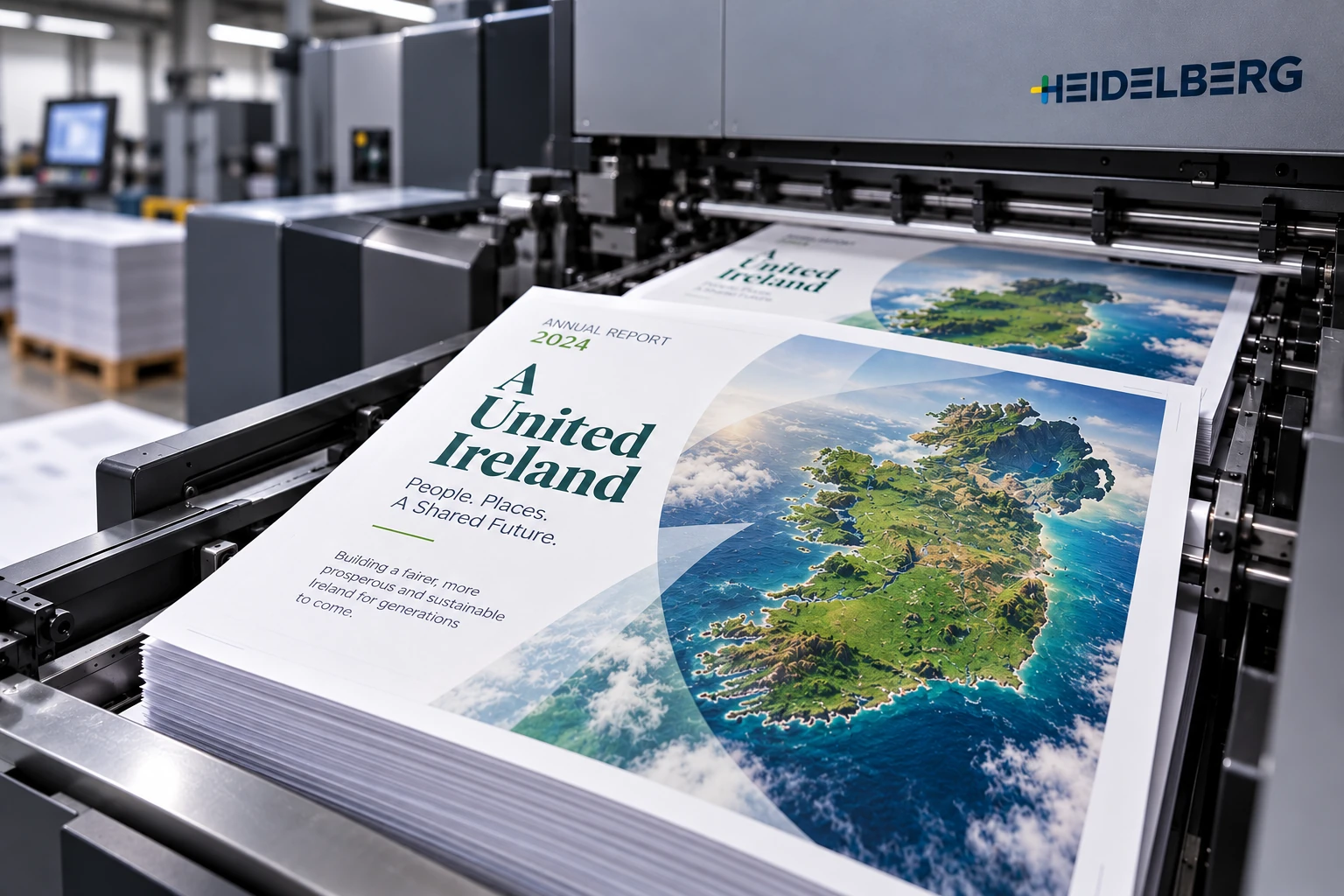
11. How Pixelo Design Can Help You Choose the Best Binding
Selecting a binding method is easier when the design and production decisions are considered together.
At Pixelo Design, we understand that an annual report is more than a collection of pages. It is an important communication tool that represents your organisation, presents your achievements and helps your stakeholders understand your work.
The binding should support that purpose.
We start with your publication's objectives
Before recommending a binding method, it is important to understand what the report needs to achieve.
Who is the intended audience? How substantial is the publication? Will it be distributed at an event, mailed to stakeholders or retained for future reference? What is the available budget?
These questions help establish the most appropriate direction.
We consider the design and production requirements together
A binding method should not be chosen in isolation from the design.
We consider the publication's format, page count, internal layout, cover treatment and overall visual identity when developing the design.
If the report is likely to be perfect-bound or PUR-bound, we plan for the spine, inner margins and cover artwork from the outset.
If saddle stitching is more appropriate, we ensure the design works with the folded booklet format and its page-count requirements.
We help you weigh up the options
There is little value in recommending a premium finish if it does not offer meaningful benefits for your project.
We can help you compare the practical considerations associated with saddle stitching, conventional perfect binding and PUR binding.
That includes discussing the desired appearance, durability, paper compatibility, production constraints and relative cost.
Where appropriate, we can also consider alternatives such as Wire-O or hardback binding.
We help create a cohesive, professional report
The best binding in the world will not compensate for poor design.
A successful annual report needs a clear structure, readable typography, consistent visual language, well-presented data and carefully selected imagery.
Pixelo Design can help bring these elements together in a publication that looks professional and communicates information effectively.
From the cover and contents pages to financial tables, infographics, case studies and the final printed specification, the objective is to create a report that feels cohesive from beginning to end.
We can help coordinate the production specification
Once the design direction has been established, the print specification needs to be confirmed.
This includes the format, paper, page count, cover, binding, finishing, quantity and delivery requirements.
The final recommendation should be based on the actual job rather than a generic assumption about which binding method is best.
Where printing is being arranged through a selected supplier, these details should be confirmed with the printer before the artwork is signed off.
We understand that every organisation is different
A large corporate report, a charity impact publication and a concise annual review have different requirements.
Our aim is to help you find the right balance between quality, functionality and cost, rather than applying the same specification to every project.
If you are planning an annual report, sustainability report, ESG publication or corporate brochure, Pixelo Design can help you develop a design and production approach that suits your organisation.
Learn more about our annual report design services at [Pixelo Design Ireland](https://pixelodesign.ie/).
12. Our Recommendation: Which Binding Should You Choose?
After considering the main options, the best approach is to match the binding to the report's length, purpose and budget.
Here is a simple guide.
| Your requirement | Recommended option |
|---|---|
| Short, economical annual review | Saddle stitching |
| Professional softcover report | Perfect binding |
| Premium report with an emphasis on adhesive performance and durability | PUR binding |
| Publication that needs to lie flat for frequent reference | Wire-O or spiral binding |
| Commemorative or exceptionally premium publication | Case binding or hardback |
For most organisations producing a substantial, professionally designed annual report, we would begin by considering perfect binding and PUR binding.
Both provide the clean, square spine and book-like appearance that work well for corporate publications.
If the report will be handled frequently, uses papers that benefit from PUR's bonding characteristics, or needs a strong and flexible adhesive construction, PUR is often the option we would favour.
If the report has a more straightforward specification and the budget is a priority, conventional perfect binding may provide an excellent result at a lower cost.
For shorter publications, saddle stitching remains a practical, economical and attractive alternative.
Ultimately, the best binding is not necessarily the most expensive one. It is the one that gives your report the right appearance, works with your chosen materials, supports the reader's experience and makes sense for your budget.
Conclusion: Make Binding Part of Your Annual Report Design
An annual report deserves careful consideration from the first design concept through to the finished printed publication.
The content, layout, paper and binding all contribute to the experience of reading the report and the impression it creates.
Saddle stitching offers an economical solution for shorter publications. Conventional perfect binding provides a clean, professional, book-like finish that suits a wide range of corporate reports. PUR binding builds on that familiar format with a flexible adhesive system that can offer valuable durability and paper-compatibility advantages.
For organisations seeking a premium softcover finish, PUR is often an excellent choice. Conventional perfect binding is also a strong option, particularly when the production requirements and budget favour it.
The important thing is to make the decision early, consider the publication as a whole and ensure that the final specification reflects the needs of your organisation and audience.
If you are preparing an annual report and are unsure which binding method is right for your project, Pixelo Design can help you work through the options.
We can help you create an annual report that combines thoughtful design, clear communication and an appropriate production specification, giving your organisation a publication you can be proud to share.
Planning your next annual report? Visit [Pixelo Design](https://pixelodesign.ie/) to discuss your project and find the right approach to annual report design and production.
Frequently Asked Questions About Annual Report Binding
What is the best binding for an annual report?
For a substantial corporate annual report, perfect binding and PUR binding are often the strongest options. Both provide a professional, book-like finish. PUR may be preferable where a flexible, durable adhesive bond is important, while conventional perfect binding can be more economical. Saddle stitching is often best for shorter reports.
What is the difference between PUR binding and perfect binding?
Perfect binding describes a method of attaching pages to a cover using adhesive. PUR binding is a form of adhesive perfect binding that uses polyurethane reactive adhesive. Conventional perfect binding often uses EVA hot-melt adhesive. PUR can provide advantages in flexibility, bond performance and suitability for certain papers.
Is PUR binding worth the extra cost?
It can be, particularly for publications that will be handled frequently or use papers for which PUR offers a bonding advantage. However, it is not automatically necessary for every annual report. Ask your printer to compare the cost and suitability of PUR with conventional perfect binding using your proposed paper and page count.
Is saddle stitching suitable for an annual report?
Yes. Saddle stitching is an excellent option for shorter annual reports and annual reviews. It is economical, lightweight and can produce an attractive booklet. Its suitability depends on the page count, paper thickness and desired presentation.
Can an annual report have a printed spine?
Yes. Perfect-bound and PUR-bound publications can have a printed spine, provided the finished spine is wide enough. Saddle-stitched booklets generally do not have a conventional flat spine suitable for printing a title.
Which binding lasts the longest?
There is no single answer for every publication. Construction quality, paper, adhesive, cover, storage and handling all influence lifespan. PUR binding can offer a strong, flexible adhesive bond, making it a useful choice for reports that will be handled repeatedly. Hardback construction may also be appropriate for publications intended to be retained for many years.
Can a perfect-bound annual report lie flat?
A conventional perfect-bound report generally will not lie completely flat without being held open. If the publication must remain open for reference, Wire-O or spiral binding may be more practical. The report's layout should also account for the inner margin and any information that crosses the spine.
Does binding affect the cost of printing an annual report?
Yes. The binding method can influence finishing costs, production requirements and turnaround time. The overall cost also depends on page count, paper, print quantity, cover finishes and other specifications. Comparing quotations based on the same underlying specification is the best way to assess the difference.
When should I decide on the binding?
Decide on the likely binding method during the early planning stages, before the cover artwork and final page layout are completed. This gives the designer time to allow for spine width, margins, page-count requirements and printer specifications.
Can Pixelo Design help with annual report binding?
Pixelo Design can help you consider binding as part of the wider annual report design and production process. By assessing your publication's purpose, format, page count, design and budget, we can help you identify a suitable direction and coordinate the design requirements with the chosen print specification.
Pixelo Design provides graphic design and corporate publication design services for organisations in Ireland and beyond. If you are planning an annual report, ESG report, sustainability report or corporate publication, visit [pixelodesign.ie](https://pixelodesign.ie/) to discuss your requirements.