Case study / Annual report design
One Family Annual Report 2025
Digital annual report design for an Irish charity
A 35-page digital annual report bringing together One Family's impact, services, strategy, advocacy, communications, governance and financial reporting in one clear and engaging publication.
Annual report design Ireland
Turning a year of complex work into a report people can understand
An annual report has an important job to do.
It needs to demonstrate impact. It needs to communicate financial information. It needs to satisfy governance and reporting requirements. It needs to explain strategy, services and organisational performance. And, increasingly, it needs to work just as effectively on a screen as it does as a downloadable document.
For organisations operating in the charity, not-for-profit and public sectors, that can create a difficult design challenge.
There is often a huge amount of information to communicate, with multiple audiences looking for different things. Funders want evidence of impact. Trustees and board members need clear governance and financial information. Service users need accessible communication. Partners and policymakers need to understand the organisation's work. And members of the public need to be able to quickly understand where money goes and what difference the organisation makes.
For One Family's 2025 Annual Report, the challenge was to bring all of that information together in a cohesive digital publication without allowing the report to become dense, intimidating or difficult to navigate.
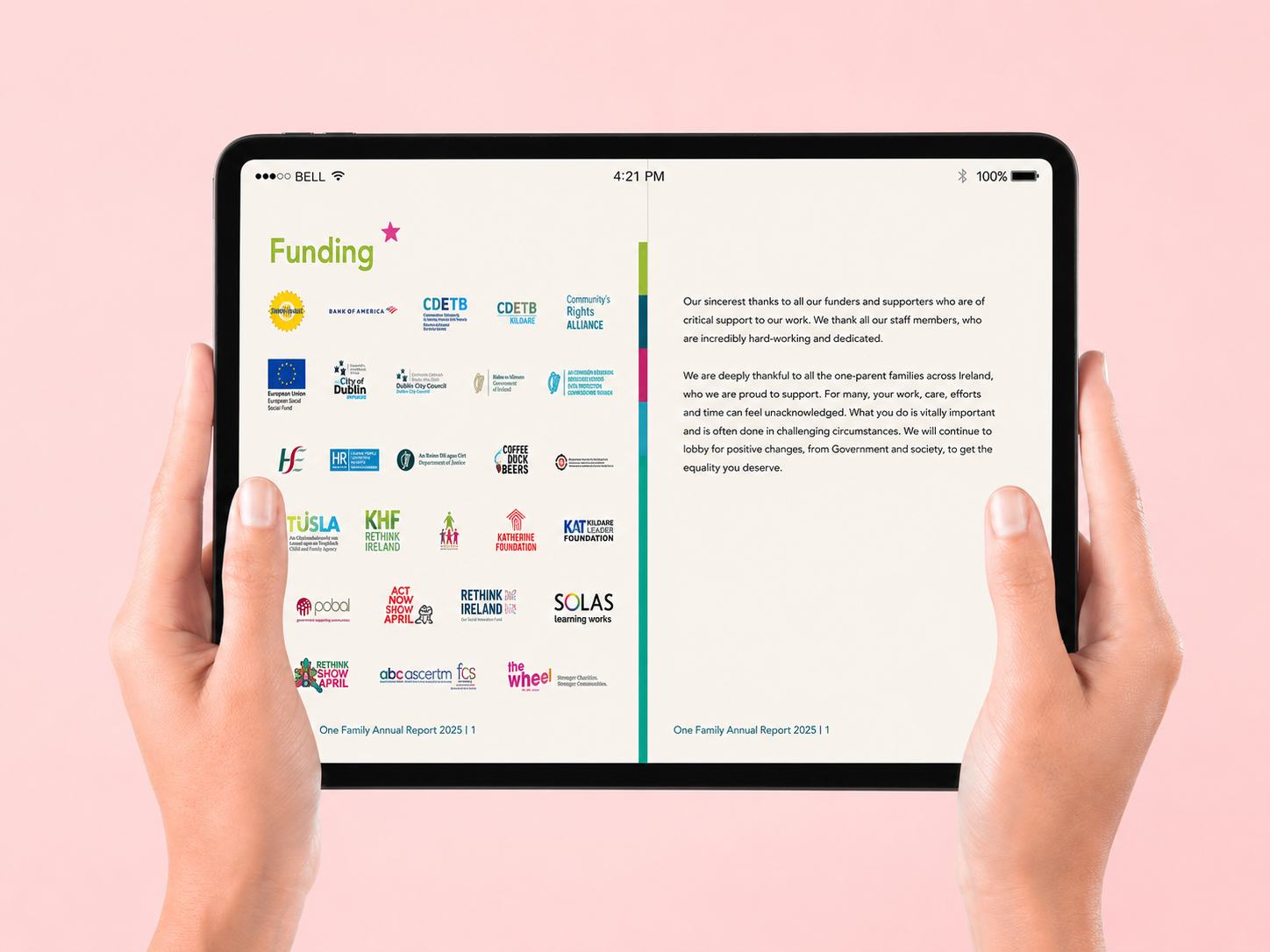
The result is a 35-page digital annual report that combines organisational information, strategy, impact, service achievements, advocacy, communications, governance, funding and financial reporting within one consistent visual system.
The challenge: communicating more than just a year's results
One Family is an organisation working to create a society that values and supports one-parent families. Its work combines specialist family support services, research and policy work. Its services include the AskOneFamily national helpline, parenting courses and mentoring, counselling, the Separating Well for Children Service, the New Futures Employability Programme and professional training.
That creates a particularly broad annual reporting requirement.
The organisation isn't simply reporting financial performance or listing a series of corporate achievements. Its annual report needs to communicate the human impact of its work alongside the systems, policies, partnerships and funding that make that work possible.
The 2025 report therefore covers a remarkably broad range of subjects.
It begins with funding and organisational information before moving through messages from the Chair and CEO, systemic drivers of inequality, the housing crisis, the New Futures Employability Programme, strategic priorities and service achievements.
It then covers adult education, the AskOneFamily Helpline, counselling, policy and advocacy, the Advocacy Project, communications, committees and memberships, organisational futureproofing, governance, the Board of Directors, financial information and detailed grant reporting.
That is the type of content architecture that can easily result in a report that feels like a collection of unrelated documents.
The role of design is to make it feel like one publication.
Designing an annual report around the reader
A good annual report shouldn't require the reader to work out how it is organised.
This is particularly important when designing a digital annual report, where readers are often viewing individual pages on a laptop, tablet or phone rather than physically turning pages.
For the One Family report, a clear editorial hierarchy helps establish a consistent reading experience.
Section headings are prominent and distinctive. Supporting information is separated into manageable blocks. Statistics are given visual prominence. Photography provides breathing space between text-heavy sections. Tables are structured carefully for governance and financial information.
The result is a publication that can accommodate very different types of content without requiring a completely different design language for every section.
This is one of the most important considerations when commissioning an annual report designer.
The design needs to be flexible enough to handle your content, rather than forcing your content into a rigid template.
Planning an annual report with this much information?
Discuss your annual reportImpact at a glance
Making impact immediately visible
For many charities, the most important section of the annual report is the impact story.
The reader needs to understand quickly:
- Who did the organisation support?
- How many people benefited?
- What services were delivered?
- What changed as a result?
- What happened during the year that matters?
- Where did funding make a difference?
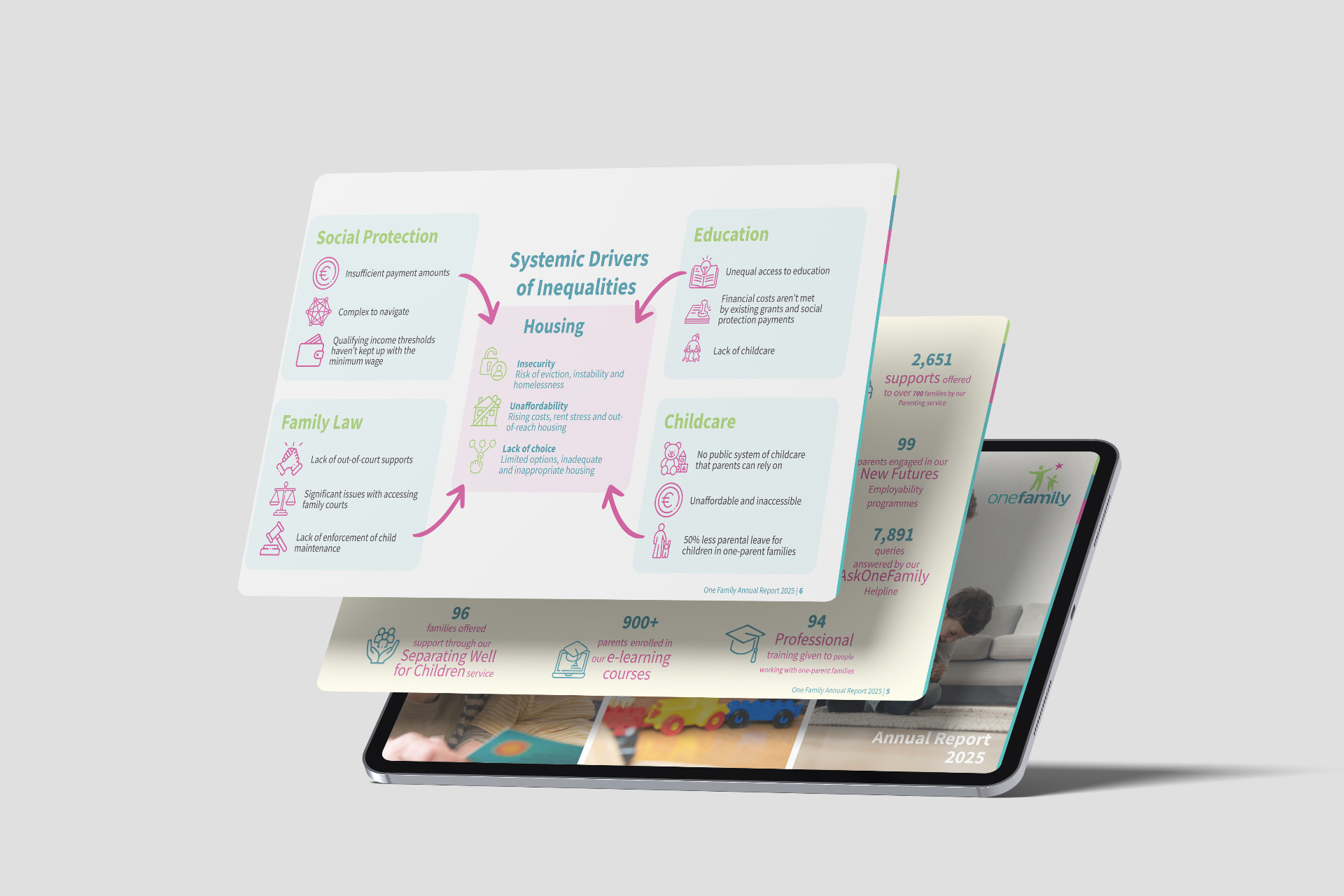
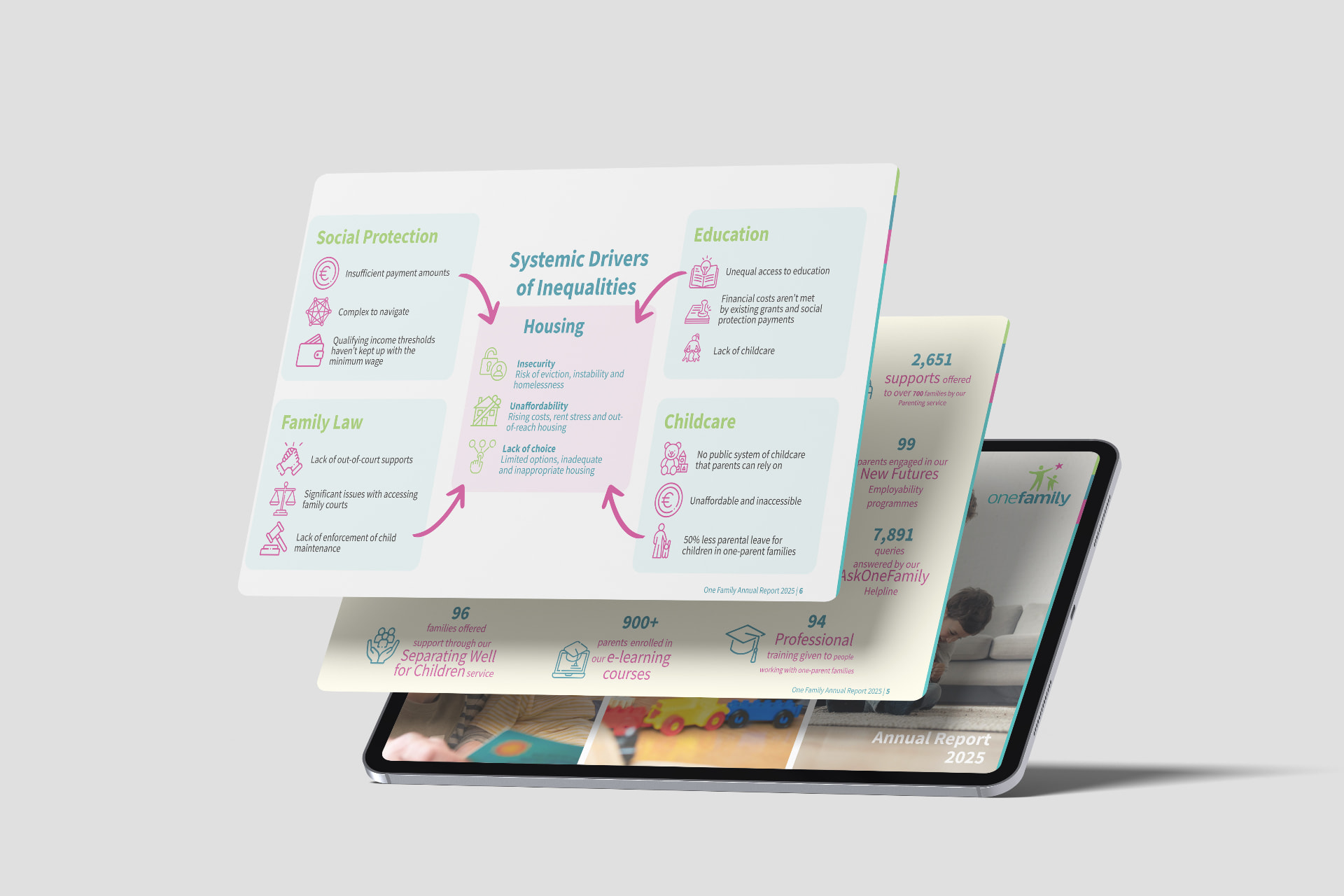
One Family's Impact at a Glance page is a good example of how statistics can be transformed into a more accessible visual story.
Rather than presenting the figures as a conventional paragraph or table, the page places key numbers around the organisation's identity and pairs them with simple illustrative icons.
7,891
Queries answered by the AskOneFamily Helpline
2,651
Supports offered to more than 700 families through the Parenting Service
913
Counselling sessions
900+
Parents enrolled in e-learning courses
346
Parents attending parenting courses and workshops
99
Parents engaged in New Futures
96
Families supported through Separating Well for Children
94
Professionals receiving training
Figures reported in the One Family Annual Report 2025.
That approach is particularly effective for digital reading.
A stakeholder can land on the page and understand the scale of activity in seconds before deciding which areas they want to explore in more detail.
This is an important principle in effective annual report design:
Don't make every piece of information compete for attention.
The most important numbers should be immediately visible. Supporting detail can then provide the evidence behind them.
Giving important stories room to breathe
Annual reports often contain difficult subjects.
For One Family, the 2025 report addresses poverty, housing insecurity, homelessness, domestic violence, childcare, family law, social protection and inequality.
The report's section on The Housing Crisis and One-Parent Families is an example of where editorial design becomes particularly important.
The content describes the impact of housing insecurity across One Family's services, including parents facing eviction, families remaining in the same home following separation because they cannot afford separate housing, and families living in emergency or precarious accommodation.
Rather than trying to reduce this subject to a few statistics, the report allows the narrative to develop across several pages.
Photography is used selectively, while typography and generous areas of background colour create separation between the different parts of the story.
That balance is important.
A charity annual report should not look like an advertisement when the content concerns serious social issues. Equally, it shouldn't become visually oppressive simply because the subject matter is serious.
Good annual report design needs to find the balance between professional, credible, human and appropriate.
Forging Ahead 2025–2027
Designing around a strategic narrative
An annual report is most effective when it tells the story of where an organisation is going, rather than simply documenting where it has been.
For 2025, One Family was beginning its new Forging Ahead 2025–2027 strategy.
The strategy is built around three central goals:
- Empower
- Represent
- Futureproof
The report explains how those goals shape service delivery, advocacy and organisational development.
The design therefore gives the strategic priorities their own dedicated section rather than burying them inside general organisational commentary.
This is something we recommend when designing annual reports for organisations with a new strategy.
If the strategy is important enough to guide the organisation's next three years, it should be important enough to have a strong presence in the annual report.
For a reader, it creates a useful progression:
What we do → what happened → what we achieved → what we learned → where we're going next.
That structure can make an annual report significantly more useful to funders, stakeholders, board members and prospective partners.
Showing real service delivery
Another challenge in annual report design is avoiding vague descriptions of activity.
Words such as support, engagement, impact and partnership can become meaningless if they aren't supported by evidence.
The One Family report counters this by combining narrative with specific results.
For example, its 2025 Service Achievements section explains that the Parenting Service supported 735 one-parent families, including 314 new referrals, while Separating Well for Children supported 242 families affected by high levels of parental conflict or domestic violence.
The same section records 34 parents attending Positive Parenting courses, 40 attending Parenting Under Pressure, 84 participating in online group courses and 917 enrolling in one of five e-courses.
The Adult Education section adds another important dimension.
The New Futures Employability Programme engaged 99 lone parents, delivered 435 individual support sessions and achieved a 66% progression rate into education or employment among participating parents.
These are exactly the kinds of figures that should be surfaced visually in an annual report.
They provide evidence.
And evidence is what turns an annual report from a corporate formality into a useful communications document.
The human story
Making room for the people behind the statistics
Charity annual reports can easily become dominated by statistics, institutional language and formal reporting requirements.
But impact is ultimately about people.
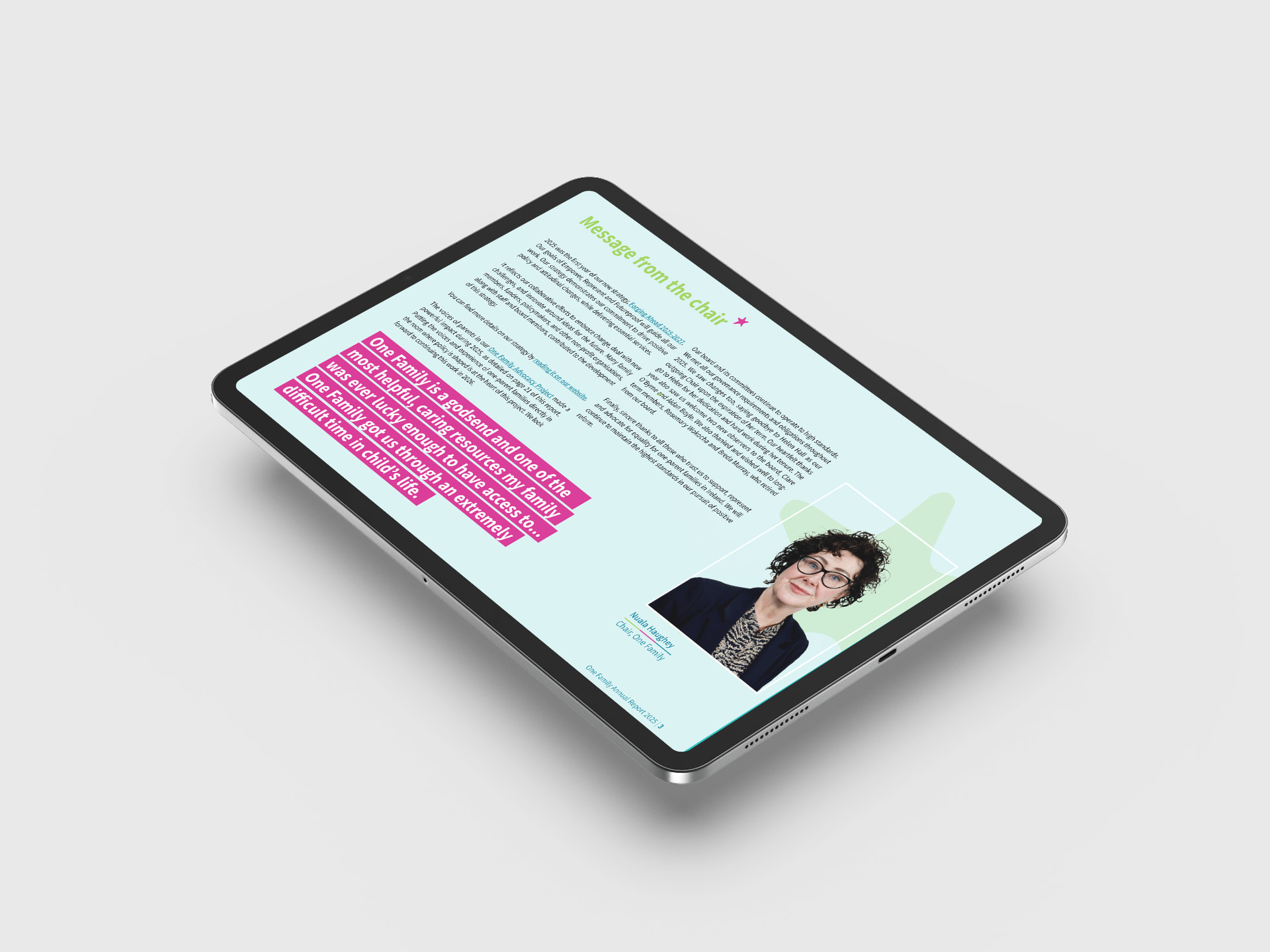
The One Family report uses photography and highlighted testimonials to give the publication a more personal dimension.
A participant's experience of New Futures, for example, is presented as a series of prominent quotations rather than being buried inside a long paragraph. This creates a visual pause within the report while allowing the reader to understand the experience behind the programme. The report also includes testimonials relating to One Family's parenting services.
For charities considering their own annual report, this is an important consideration.
If you have stories, testimonials or case studies that demonstrate the difference your organisation makes, they should be considered part of the report's core content — not simply something added at the end.
Making digital annual reports more than a PDF
A digital annual report should not simply be thought of as a printed report saved as a PDF.
The fundamental content may be similar, but the way people interact with it is different.
Digital readers scan. They jump between sections. They look for statistics. They search for particular terms. They may arrive at an individual page without seeing the cover. They may read the report on a laptop one day and a tablet the next.
That means digital annual report design needs to consider screen-based hierarchy, navigation, readability, file performance and accessibility from the beginning.
The One Family report is particularly suited to digital presentation because its information has been broken into clearly defined editorial sections, with prominent headings, short content blocks, statistics, photography, pull quotes and structured tables.
Its contents page also provides a useful overview of the report architecture, taking the reader from Funding and About Us through Strategy, Services, Advocacy, Communications, Governance and Financial Overview.
When commissioning a digital annual report, these structural decisions should be discussed at the beginning of the project, not after the design has been completed.
One report, many readers
Designing for multiple audiences
One of the hardest annual report design problems is that there isn't one reader.
A charity's annual report may need to work for:
- Funders who want to see whether their investment is producing meaningful outcomes.
- Government departments who need evidence of activity, expenditure and compliance.
- Trustees and board members who need governance and financial information.
- Staff and partners who want to understand organisational progress.
- Service users who want to see whether the organisation understands their experiences.
- Journalists and policymakers who may be looking for evidence to support wider discussions.
- Members of the public who simply want to understand what the organisation does and where its money goes.
One report has to accommodate all of them.
This is why good annual report design isn't just about making pages attractive.
It is about creating different levels of information.
A reader should be able to skim. A stakeholder should be able to investigate. A funder should be able to find evidence. A board member should be able to find governance information. And someone who wants the complete story should be able to read the report from beginning to end.
Keeping governance information readable
Governance sections are rarely the most visually exciting part of an annual report.
They are, however, among the most important.
The One Family report contains detailed information about its Board of Directors, board succession, board transitions, conflicts of interest, board meetings and committee structures, alongside financial reporting and detailed grant disclosures.
This is where structured typography, considered table design and consistent spacing matter. Governance information should be easy to check, not difficult to read.
It should help readers understand why it mattered.
Financial overview
Presenting financial information professionally
Financial reporting is often one of the areas that clients are most concerned about when commissioning an annual report.
The information needs to remain accurate while being presented in a way that readers can understand.
One Family's 2025 financial overview reports total income of €1.91 million, an increase of 12.1% on 2024, and total expenditure of €1.88 million, an increase of 11.9%. The organisation recorded a surplus of €32,925.
The report also records general reserves of €497,685, equivalent to approximately 3.3 months of operating costs.
€1.91m
Total income, up 12.1% on 2024
€1.88m
Total expenditure, up 11.9% on 2024
€32,925
Surplus recorded for the year
€497,685
General reserves, approximately 3.3 months of operating costs
For a designer, the objective is to establish hierarchy around this information without compromising accuracy.
Important headline figures should be easy to locate, while detailed financial information still needs to remain legible and appropriately structured.
Bringing advocacy to life
One Family's work also extends beyond direct service provision into policy and advocacy.
The 2025 report documents submissions to government departments, appearances before Joint Oireachtas Committees, research partnerships and the development of the One Family Advocacy Project.
The Advocacy Project had 123 lone parents signed up, with members participating in lobbying events and contributing to policy and media activity.
A dedicated section then explores the project's 2025 impact, including advocacy workshops, information sessions, one-to-one sessions and webinars.
It also describes how parents' lived experiences were brought into national discussions including the Social Inclusion Forum and Child Poverty Summit.
This is another reason why a one-size-fits-all annual report template rarely works for complex organisations.
Different forms of impact require different forms of communication.
Service statistics may need large numbers. Policy work may need timelines. Research may need quotations and references. Governance may need tables. Financial reporting may need charts.
The design system needs to accommodate all of them.
A report built to contain complexity
The One Family annual report is a good example of why annual report design is fundamentally an information-design project.
There are 35 pages. There are numerous service areas. There are statistics, testimonials, strategy statements, policy submissions, governance information, board tables, committee attendance, risk information, remuneration information, financial figures and detailed grant disclosures.
The funding section alone includes detailed information about individual grants, their purposes, terms, amounts recognised and deferred balances.
That level of complexity cannot be solved simply by choosing attractive fonts and photographs.
It requires editorial thinking. It requires understanding the hierarchy of the information. It requires knowing what deserves emphasis and what needs to remain detailed. And it requires a design system capable of maintaining consistency across dozens of different content scenarios.
Planning an annual report with this much information?
Start your reportBefore you brief a designer
What should you provide your annual report designer?
If you're responsible for commissioning your organisation's next annual report, you may be wondering what you need to prepare before contacting a designer.
The good news is that you don't need to have everything worked out.
A good annual report designer should be able to help you establish the structure.
Typically, we would recommend gathering:
- 01
Your previous annual report
This establishes what has worked, what hasn't and what needs to change.
- 02
Your content
This may include Word documents, spreadsheets, financial information, board information, service statistics and supporting material.
- 03
Your brand guidelines
If you have them, these help ensure the report feels consistent with the rest of your organisation's communications.
- 04
Your photography
Good-quality photography can transform an annual report. If photography is limited, a designer can help determine where imagery, graphics or illustration can work instead.
- 05
Your key messages
What do you most want readers to understand about the year?
- 06
Your audience
Tell your designer who needs to read the report and what they need to find.
- 07
Your deadline
Annual reports often involve multiple approval stages, so establishing the final publication date early is important.
How long does annual report design take?
The timescale depends on the number of pages, the complexity of the content, how complete the copy is and how many people need to review and approve the report.
A straightforward 20–30 page report can be considerably quicker to design than a 60–100 page report containing extensive governance tables, financial information, infographics and multiple rounds of stakeholder review.
The important thing is to involve the designer early.
If the deadline is close, the designer needs to know immediately.
This allows the project to be structured around content delivery, first concepts, page production, amendments, proofing and final artwork.
For a digital annual report, additional consideration should be given to final PDF preparation, links, accessibility and screen optimisation.
How much does annual report design cost in Ireland?
There isn't a meaningful single price for annual report design because the amount of work can vary enormously.
A 20-page report with supplied copy and straightforward layouts is a very different project from an 80-page publication requiring information design, charts, infographics, tables, image sourcing, extensive amendments and accessibility preparation.
When comparing annual report design quotes, don't just compare the number at the bottom of the proposal.
Ask what is included.
Does the quote include:
- Creative direction?
- Page design?
- Infographics?
- Charts?
- Image sourcing?
- Copy formatting?
- Multiple rounds of amendments?
- Accessibility?
- Digital PDF preparation?
- Print-ready artwork if required?
- Project management?
- Final proofing?
A lower quote isn't necessarily cheaper if significant parts of the process are excluded.
Should your annual report be digital or printed?
For many organisations, the answer is both.
A digital annual report offers significant advantages. It can be distributed immediately. It can be emailed to funders and stakeholders. It can sit on your website. It can be shared through social media. It doesn't require printing or postage. It can potentially include clickable navigation and links. And it provides an accessible format for audiences who prefer reading on screen.
A printed annual report can still have an important role for AGMs, stakeholder meetings, board meetings, funders, government representatives and other key audiences.
The decision should therefore be based on how your organisation actually communicates.
For a digital-first report, however, the design should be created with the screen in mind from the outset rather than simply treating digital output as an afterthought.
What makes a good digital annual report?
A strong digital annual report should answer five questions quickly.
- What does this organisation do?
- What happened during the year?
- What difference did it make?
- How is the organisation governed and funded?
- What happens next?
The One Family report addresses these questions through a clear sequence covering purpose, strategy, impact, services, advocacy, communications, governance and finances.
Its final financial and grant sections then provide the detailed evidence required to support the broader story.
That combination of accessible overview and detailed supporting information is one of the most useful models for a modern charity annual report.
Our approach
What makes Pixelo different?
At Pixelo, we don't see an annual report as simply a document that needs to be formatted.
We see it as a communication tool.
The objective is to take everything your organisation needs to report and turn it into something your stakeholders can actually understand.
That means asking questions before opening InDesign.
- What are the key messages?
- Who is reading this?
- Which figures matter most?
- Where is the evidence of impact?
- Which information is legally or regulatorily required?
- What should readers notice first?
- What can be condensed?
- What needs more space?
- Where should photography be used?
- How will the report work digitally?
And how can the finished publication support your organisation after it has been published?
These decisions make the difference between a report that merely contains information and a report that communicates it effectively.
Your annual report is more than a compliance document
For many organisations, the annual report is one of the few publications that brings everything together.
It tells your stakeholders what you achieved. It demonstrates responsible stewardship of funding. It communicates your strategy. It records your governance. It provides evidence of impact. It gives your team something to be proud of. And it creates a permanent record of the organisation's work during the year.
So it deserves more consideration than simply putting the supplied text into a template.
The One Family 2025 Annual Report demonstrates how a complex mix of human stories, service statistics, strategic priorities, advocacy activity, communications results, governance information and financial reporting can be brought together into one coherent publication.
The organisation reported 26 pieces of earned media coverage during 2025, 23 of them in national media, alongside significant growth across Instagram, Facebook and LinkedIn. Its website also underwent a major update focused on navigation, appearance and accessibility.
The annual report therefore sits within a much wider communications ecosystem.
It isn't an isolated document.
It is another opportunity to explain who you are, what you achieved and why your work matters.
Questions about annual report design
Annual Report Design FAQs
How long does annual report design take?
The timescale depends on the number of pages, the complexity of the content, how complete the copy is and how many people need to review and approve the report. A straightforward 20–30 page report can be considerably quicker to design than a 60–100 page report containing extensive governance tables, financial information, infographics and multiple rounds of stakeholder review. The important thing is to involve the designer early.
How much does annual report design cost in Ireland?
There isn't a meaningful single price for annual report design because the amount of work can vary enormously. When comparing quotes, ask what is included: creative direction, page design, infographics, charts, image sourcing, copy formatting, amendments, accessibility, digital PDF preparation, print-ready artwork, project management and final proofing.
Should our annual report be digital or printed?
For many organisations, the answer is both. A digital annual report can be distributed immediately, emailed to stakeholders, hosted on your website and shared through social media. A printed report can still have an important role for AGMs, board meetings and key audiences. The decision should be based on how your organisation actually communicates.
What makes a good digital annual report?
A strong digital annual report answers five questions quickly: what does this organisation do, what happened during the year, what difference did it make, how is the organisation governed and funded, and what happens next. An accessible overview supported by detailed evidence is one of the most useful models for a modern charity annual report.
What should we provide our annual report designer?
Typically we recommend gathering your previous annual report, your content, your brand guidelines, your photography, your key messages, your audience and your deadline. You don't need to have everything worked out; a good annual report designer will help you establish the structure.
Can annual reports include financial and governance information?
Yes. Governance and financial sections are among the most important parts of an annual report. Structured typography, considered table design and consistent spacing keep board information, committee structures, financial reporting and grant disclosures easy to check and read.
Can a designer work from supplied content?
Yes. Content can be supplied as Word documents, spreadsheets, financial information, board information and service statistics. The design work then covers structure, editorial hierarchy, layout, information design and final artwork.
Can you design annual reports for charities and not-for-profit organisations?
Yes. Charity and not-for-profit annual reporting is a core part of our work, alongside annual, ESG, sustainability, government and accessible report design.
Related services
Related Report Design Services
Annual Report Design
Editorial design for annual reports in print and digital formats.
Accessible Reports
Accessible PDF design planned into the publication.
Infographic Design
Turning statistics into information readers understand.
Government Report Design
Structured publications for departments and public bodies.
ESG Report Design
Clear information design for complex disclosures.
Animated Explainer Videos
Turn report highlights into clear visual stories.
You can also view more case studies or contact Pixelo Design.
Start a conversation
Planning your next annual report?
Whether you're a charity, not-for-profit organisation, public body, professional association or community organisation, your annual report probably contains more information than you initially realise.
The challenge is making that information work together.
Pixelo can help you structure, design and produce a professional annual report that is clear, engaging and appropriate for your audience.
From a concise 20-page digital report to a complex publication incorporating extensive governance, financial reporting, charts, statistics, photography and infographics, the approach is tailored to the organisation and the content.
Tell us what you're reporting, when you need it and what format you're considering. We'll help you work out the most effective approach.